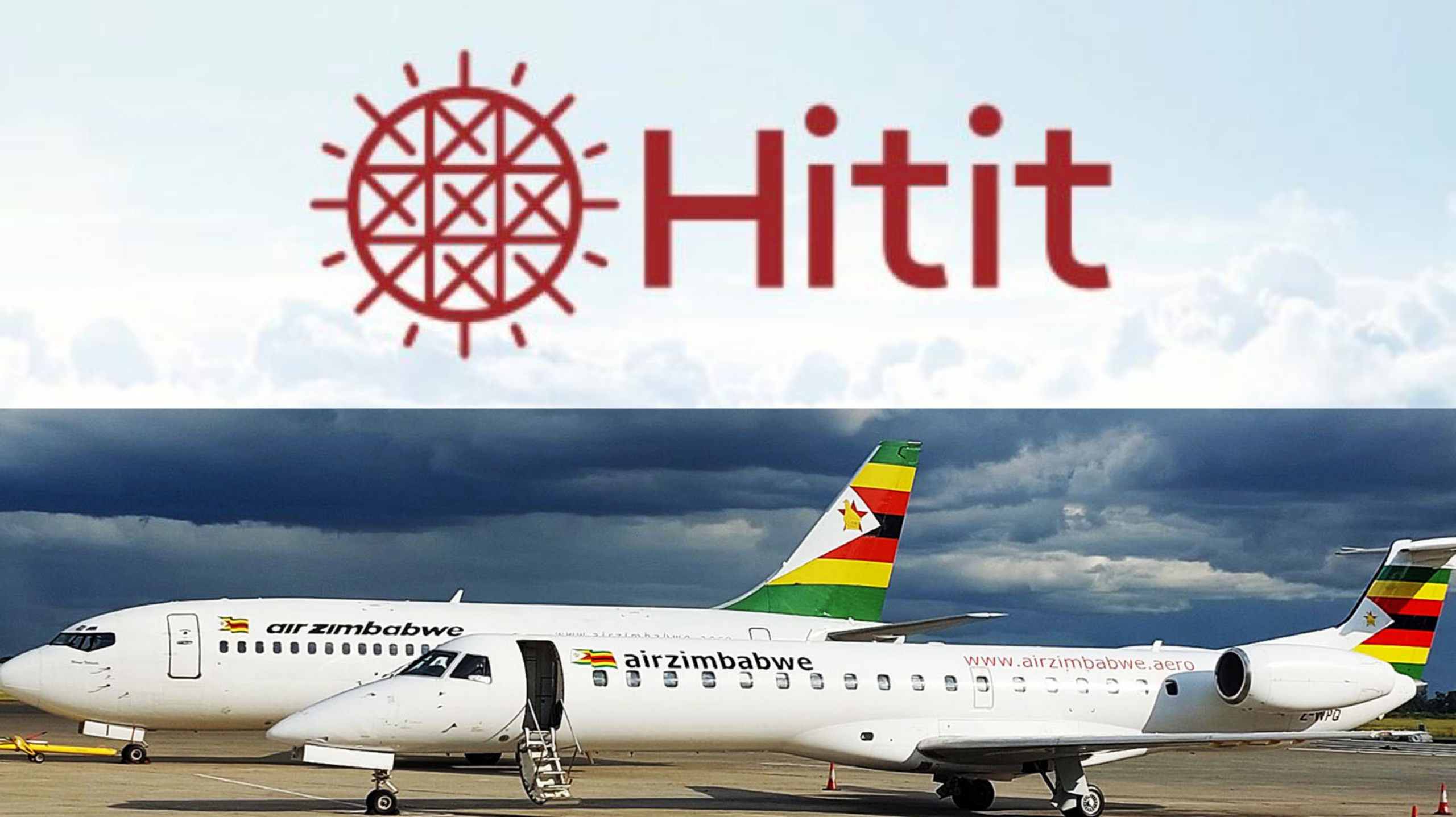
There is real motion behind Air Zimbabwe's return to London, and most of it is happening where its passengers cannot see it. As of 8 June the airline switched on a new reservation and online booking platform, the engine that sells and manages its seats, weeks before its scheduled 1 July return to the route. After years of decline, that is concrete, encouraging preparation, and The Mutapa Times is first to connect this upgrade to the relaunch.
Yet the news of it reached the public the way the route did: through a corporate channel, not a word to passengers. The systems go-live surfaced in a stock-market filing in Istanbul. The route was confirmed by a press release from a Spanish partner. Weeks from the first flight, the airline still has not told its own customers the route exists, when it flies, or how to buy a seat.
The quiet part: a new engine to sell seats
The substantive news first, because it is real. According to a disclosure to Turkey's public markets platform by the aviation software firm Hitit Bilgisayar, Air Zimbabwe went live on the back end, 8 June with a major upgrade of its Crane suite: Crane PAX for reservations, Crane IBE, the internet booking engine, and Crane RA for revenue accounting. If you tried to go on their website and it was down this is why.
This is the layer that takes a booking, issues the ticket and counts the money. Replacing it is not cosmetic.
It builds on what is already there. Air Zimbabwe has run Hitit's departure control system since a 2021 agreement. So this is a carrier that quietly modernised its ground systems three years ago and has now extended that to the systems that sell seats, in the same month it reopens its flagship route. In fairness on scale, Istanbul analysts rated the deal only "limited positive" for Hitit's own shares: incremental modernisation, not a moonshot. But solid plumbing, installed before the guests arrive, is still progress.
Announced everywhere except to passengers
Here the motion in the background runs into the silence out front. For the second time in a week, major Air Zimbabwe news reached the public only through a corporate document: the London route in a Plus Ultra press release, the systems upgrade in a supplier's stock-market filing. In both cases the airline's own customers were addressed last, if at all. Weeks out from 1 July there is still no announcement to passengers. They noticed.
@RobCSAdams · 6 June
Launching in a month, yet no mention of these flights on the AirZimbabwe web site? No listing on any of the flight consolidator sites? How do you buy a ticket? What's the flight frequency? I'll believe it when I see it.....
@TheAssegai
Has Air Zimbabwe even fixed their website for them to be talking about flying UK
Then on the morning of 8 June, with search interest at its monthly peak and a new booking engine going live that same day, the official account did post. Not the route. Not a fare. Not a booking link. A customer-satisfaction survey.
@FlyAirZimbabwe · 8 June
Your experience matters to us. Tell us how we're doing, what we're getting right and where we can do better. It takes just a few minutes. #FlyAirZim #CustomerExperience
The demand was at the door. The airline sent out a feedback form.
The demand is here, and measurable
Search interest for "Air Zimbabwe" had drifted in the mid-20s to low-30s through late May. As the London news broke it jumped, to 56, 64 and 59 across 6 to 8 June. The United Kingdom signal, the paying end of the route, is starker: flat for weeks, then 11, then 54, then a maximum reading of 100 on 8 June.
The breakout queries say it plainly: worldwide, "air zimbabwe online booking" was a breakout term; in the UK, "air zimbabwe flights" surged. This was high-intent, ready-to-pay demand, the kind marketing teams spend fortunes to manufacture. Air Zimbabwe got it for free, in the exact week its new booking engine came online, and had nowhere to send it. Demand on this curve does not wait. It converts on a competitor's site, or it cools. There is no second launch day.
What that demand actually found
We did what a curious traveller would. The instinctive address, airzimbabwe.com, no longer belongs to the airline; it resolves to a near-empty holding page and has been offered for sale. The single most valuable piece of digital real estate the carrier could own now points its customers elsewhere.
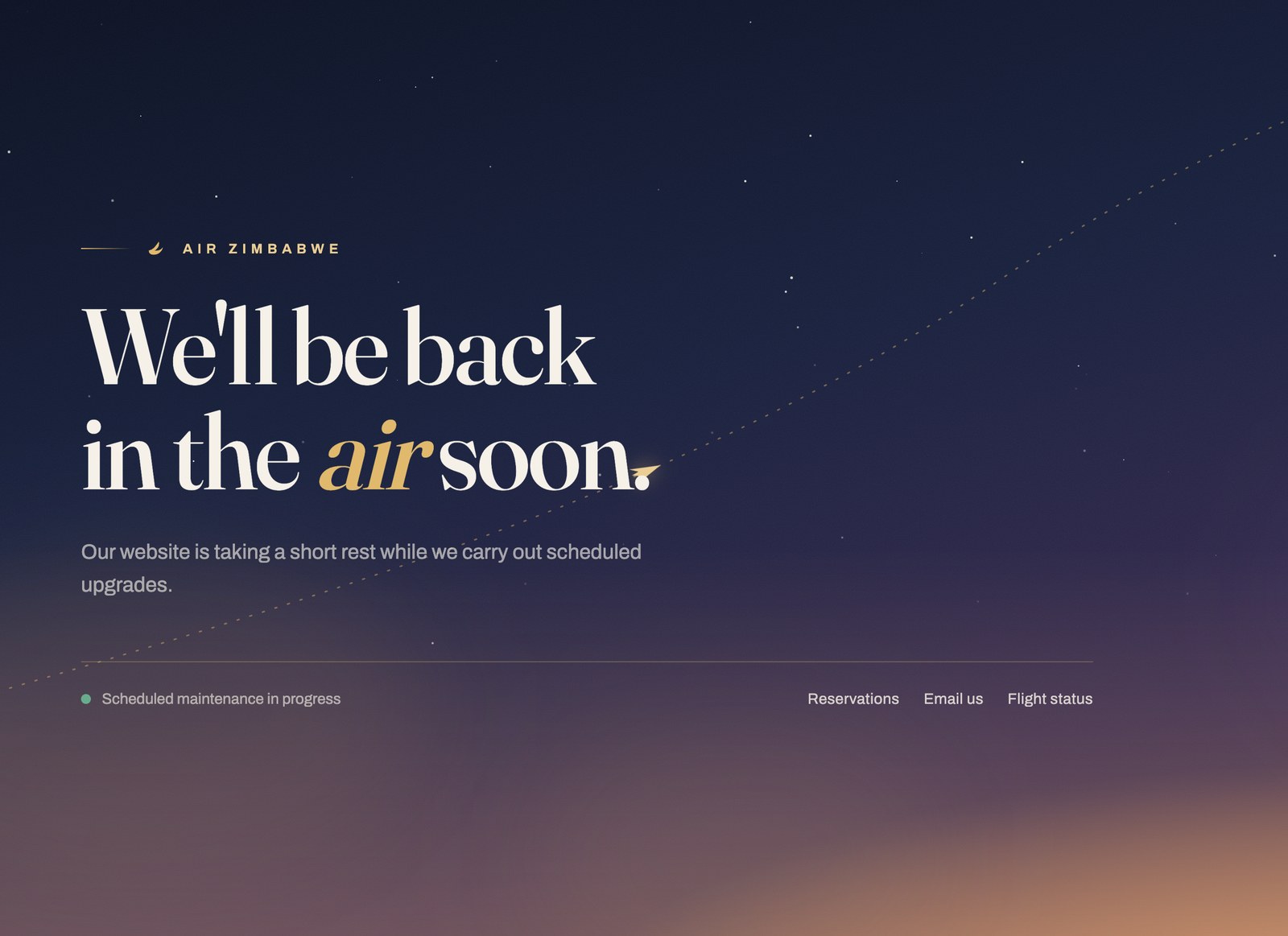
The airline's actual website lives on airzimbabwe.aero, and at the height of the surge it was not a website at all, but a "scheduled maintenance" holding page. We now know that maintenance was the systems cutover above, which cuts both ways: a brand-new booking engine went live on the back end the day demand peaked, and the travellers driving it could not reach the door, because the door was boarded up and unmarked.
How the .com slipped away
As an Internet Archive capture from 2012 shows, airzimbabwe.com was a working booking site, already selling the very route now being relaunched: a search box set London to Harare, and a "Web Special Fare, London Harare Return from £300." The airline once sold London online. Today it cannot.
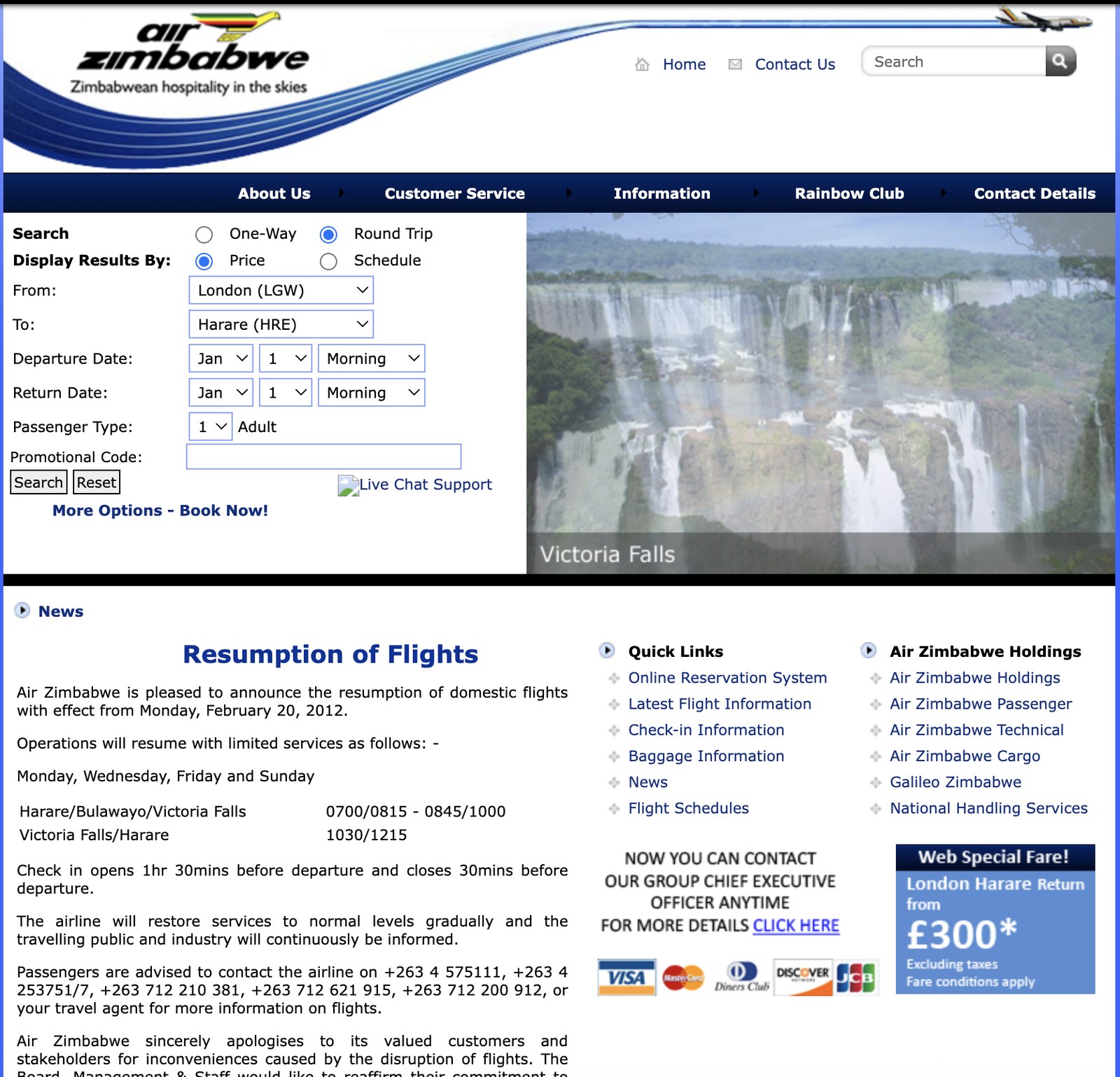
Archive records show the .com served the airline until around 2017, after which it passed out of the carrier's hands. We cannot state why with certainty, but the timing lines up with its deepest financial crisis, a period of grounded and impounded aircraft and well-documented unpaid debts, and the most common way a national carrier loses its domain is mundane: a renewal invoice unpaid while bigger fires burn. Once a .com is gone, getting it back is rarely cheap and never quick.
Why sitting on a .aero is not enough
The airline now operates from a .aero address, a legitimate but niche aviation domain. It is not where ordinary travellers instinctively go, and it does not carry a .com's trust signal for someone about to enter card details, especially a customer who has just read that the airline spent years on a safety list.
The rest of the industry treats the .com as core infrastructure, not vanity. American Airlines secured american.com once it came free. Air France used the WIPO Arbitration and Mediation Center to recover airfrances.com from a typosquatter, and Singapore Airlines did the same for singaporeairlines.com, both won on the ground that a famous airline name in the wrong hands is registered in bad faith. The tools exist. They have simply not been used here.
The fix: capture this interest now
Market share is the stated goal of this relaunch, and it is won at the moment a customer is ready to choose. For Air Zimbabwe, that moment is happening now and going to waste. The website should have been the first aircraft made airworthy: a fast landing page on every address the airline controls, with a "Harare to London is coming, register for launch fares" capture, building an email list ahead of the first flight.
None of this is hard, and that is the frustrating part, because the hard part, the systems, is already done. Three steps, today. One, put a real page behind airzimbabwe.aero with a working link into the new booking engine and an email capture. Two, tell customers directly, on the airline's own channels, that the route exists and how to buy. Three, recover or redirect the .com, by purchase if it is merely parked or through a UDRP complaint if it is squatted on the airline's name. The demand is already there and already paid for. The engine is switched on. The only thing missing is the airline turning to face its own customers.
2027: the battle for Harare to London
The timing of the fumble matters, because Air Zimbabwe is not stepping into an empty sky. The Harare to London corridor is one of the most contested premium routes out of southern Africa, and in practice it is owned by the one-stop carriers: Ethiopian Airlines through Addis Ababa, Kenya Airways through Nairobi, RwandAir through Kigali, Etihad through Abu Dhabi. Each has spent years building the loyalty, schedules and fares that many Zimbabwean travellers now treat as the default way home.
It is a safe bet that, as you read this, there is a room in Addis Ababa where Ethiopian Airlines is working out how to defend its share, with the budget and route data to do it. Serious incumbents pre-empt rather than wait. A credible non-stop is a direct threat to a one-stop that costs a passenger the better part of a day, and the good news is for the traveller above all: competition reliably improves the deal. If the return forces Ethiopian, Kenya Airways, RwandAir and Etihad to keep fares keen and lift service, every Zimbabwean flying to London wins, on Air Zimbabwe or not.
That sets up 2027 as a real contest. Air Zimbabwe holds one honest, powerful card: the convenience and speed of a non-stop, which no amount of hub loyalty can shorten. The open question is whether it will also compete on price, or lean on the non-stop premium alone. Win on both and it has a proposition the one-stops cannot easily answer. Win on neither the website nor the welcome, as the past two weeks suggest, and convenience will not carry the route by itself. The aircraft is the easy part.
Sources, in full
- Systems upgrade (Crane PAX, IBE, RA), 8 June 2026: Hitit Bilgisayar disclosure on Turkey's Public Disclosure Platform, KAP filing; corroborated by brokerage analysis (Deniz Yatirim / ForInvest) via Uzmanpara / Milliyet and Paratic.
- Departure control system since 2021: Hitit Computer Services on the Crane DCS deployment at Air Zimbabwe, company post.
- Search demand: Google Trends, "Air Zimbabwe", worldwide and United Kingdom, 8 May to 8 June 2026 (interest over time and breakout queries).
- Domain status: direct checks of airzimbabwe.com (holding page, offered for sale) and airzimbabwe.aero (scheduled-maintenance page), 6 to 8 June 2026; historical ownership via the Internet Archive.
- Industry domain precedent: WIPO Arbitration and Mediation Center, Air France v. airfrances.com (D2018-2421) and Singapore Airlines v. singaporeairlines.com (D2000-0643).
- Safety context: UK Civil Aviation Authority, UK Air Safety List, 31 October 2025 (PDF).
- Route confirmation: Plus Ultra Lineas Aereas press release, 5 June 2026, plusultra.com.
- Passenger reaction: public posts on X from @RobCSAdams (6 June), @TheAssegai, and @FlyAirZimbabwe (8 June), quoted as published.
Editor's note: Search figures are from Google Trends (worldwide and GB, 8 May to 8 June 2026). Domain status was checked directly and against Internet Archive records; attributing the .com loss to the airline's debt era is informed inference, not a confirmed cause. Quoted posts are public on X at the time of writing. We have sought comment from Air Zimbabwe and will update this article with any response.