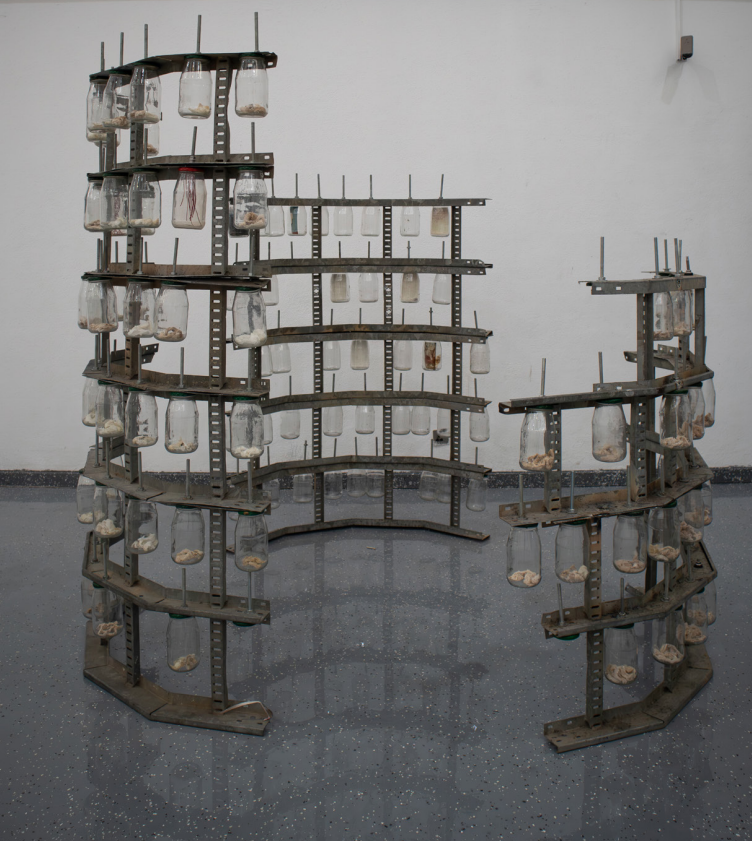
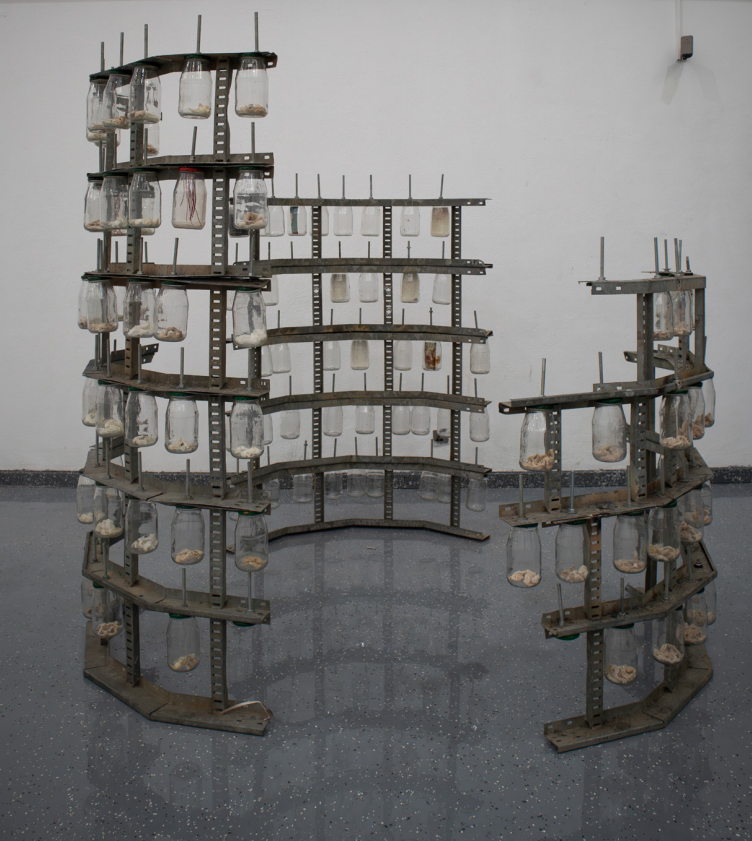
We will admit something: on the first walkthrough of the pavilion, on Wednesday afternoon, we walked past Pardon Mapondera's Gone, but not forgotten. The installation is shy in its opening posture. It occupies an inner room. The jars are small and they are many; the steel framework that holds them looks, on first encounter, like the back-of-house shelving of a small natural-history museum somewhere in eastern Europe. We did the wrong thing and moved through quickly. We came back twice, deliberately, and stood for the better part of an hour in front of it. It is, on reflection, the most quietly devotional installation we encountered in the Biennale.
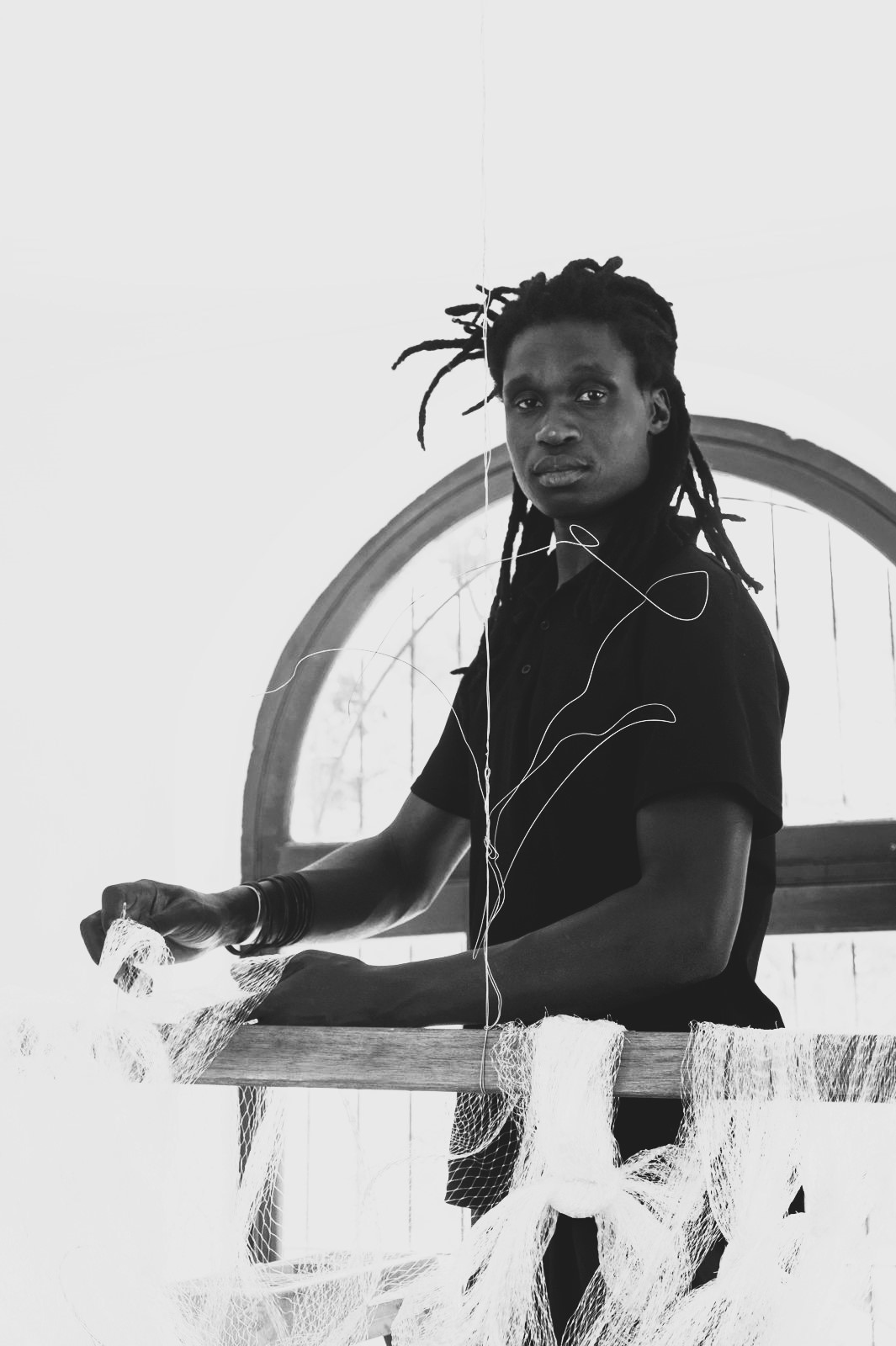
Mapondera, born in Harare in 2003, is the youngest of the five artists in the pavilion in disposition if not strictly in date; his practice carries the energy of a working studio at full velocity. He has built his career out of the materials that contemporary consumer society discards, plastic bottles, straws, thread, mayonnaise jars, perspex, cable ties, and out of a sustained, openly theological engagement with what those materials, transformed, can be made to hold.
What the jars hold
A single jar in Gone, but not forgotten, there are some hundreds in the installation, repurposed mayonnaise containers of the kind that pass through Zimbabwean kitchens by the thousand, holds the following items: a small handful of soil, a length of cotton string, and a folded fragment of a photograph. The components are simple. The accumulation is enormous. The cumulative effect, in the room, is closer to the experience of standing inside a charged reliquary than the experience of viewing a contemporary sculpture.
This is not metaphorical. Mapondera's catalogue interview is direct about the intention. I started by talking to these objects then asking questions like where are you coming from. Some of the message I portray will be from the life background of the material. The jars have a history. They are not props. They were, in their previous lives, the containers of an everyday Zimbabwean foodstuff; they carry, in Mapondera's reading, the residue of the kitchens they passed through and the meals they enabled. To repurpose them as the vessels of a memorial installation is, in his terms, a continuation of their function rather than a break from it. They are still containing the same kinds of things. They are just now containing them on the wall of a Venetian church.
The emotional weight of the work is bound up with this transformation. Gone, but not forgotten names a structure of grief, the kind of grief whose object cannot be recovered but whose memory has to be held somewhere. The installation provides the somewhere. Each jar, in the cumulative logic of the work, is a unit of mourning held inside a domestic vessel. The viewer walks into a room of these and is, very quickly, no longer the subject of the encounter. The room is.
Therapy, in his word
Mapondera, in the catalogue interview, declines to describe his process as labour. The word he uses is therapy. I don't find it as labour. I find therapy in it. They heal me, that's why I keep on doing it. The remark is easy to dismiss as the casual shorthand of someone speaking quickly to an interviewer. We think it is precise.
What Mapondera is doing, at the bench, with the materials he has gathered, is repetitive, physically intricate, and slow. The jars have to be cleaned. The string has to be cut to length. The photographic fragment has to be folded just so. The soil has to be measured. The cable ties have to be tightened to the exact tension at which the installation will hold without distorting the perspex above it. Each of these steps is, in the strict sense, therapy: a structured, repeating, attention-demanding practice. The therapy is in the work, and the work is the visible record of having done the therapy.
This is the part of contemporary art-making that is least visible in the gallery and most consequential in the studio. Most installations of this scale would have been produced by a team of assistants under the artist's direction. Mapondera, as far as we can tell from his account and from the marks of the hand on the work itself, makes these pieces almost entirely himself. The labour is the meditation. The installation is the meditation made visible.
On Vadzimu, and on what the work asks of its viewer
Mapondera's 2025 solo exhibition at the National Gallery of Zimbabwe, Dotipaiwo Chiedza, Let Us Follow the Light, was the moment at which the spiritual dimension of his practice became impossible to ignore. The exhibition was framed, in the artist's own words, as a prayer addressed to Vadzimu, ancestral spirits, and to Musikavanhu, the creator of humanity. The critical writing around it described the show as a muted shrine and a site for divine intervention. We did not see Dotipaiwo Chiedza. The pavilion contribution, on the evidence of the room at Santa Maria della Pietà, is the continuation of the same project.
What Mapondera is offering, in plain terms, is the proposition that African spiritual practice, and specifically the strand of Shona spirituality that names ancestral guidance as a living, ongoing form of address, is a serious epistemology and not a piece of cultural decoration. The jars are not aesthetic props. They are vessels in the strict ritual sense. The hanging perspex form Ngwarai Vanangu, which the catalogue translates as a warning addressed to the artist's children, is not a metaphorical warning. It is, on the artist's account, a literal one.
This is the proposition that most contemporary art audiences are least equipped to receive. The art world has, over the past twenty years, developed a fluent vocabulary for talking about spirituality as a theme. It has had a much harder time letting itself be addressed by an actual spiritual practice. Mapondera's work is uninterested in the distinction. It treats the viewer as someone the work is, in some real sense, speaking to, not someone the work is about. The work was, in his account, made under the supervision of ancestral interlocutors. The viewer either lets that proposition stand or they do not. The room does not negotiate.
The ecology, then
It is impossible to write about Mapondera without addressing the ecological reading of his work, and we will, briefly. He is using waste plastic. He is, by the simple fact of selecting it from the discard stream, making an argument about consumption and persistence, about the long tail of materials whose useful life is measured in months and whose physical life is measured in centuries. Plastic, in Mapondera's hands, is forced to perform a function commensurate with its actual durability. It is asked to carry memory, and memory is the only thing in human life that has the same staying power.
But the ecological reading is, on its own, insufficient. What distinguishes Mapondera from the much larger field of contemporary artists making work about waste is that the waste, in his hands, is not the subject. The subject is what the waste, transformed, can hold. The ecology becomes, in this configuration, a matter of fact rather than a matter of argument. The artist is not pointing at the environmental problem. He is simply working with the materials that the problem has produced, in the same spirit in which Eva Raath works with old patchwork squares and Gomo works with discarded number plates. Repurposing is not, in any of these practices, a stylistic choice. It is the underlying condition of working at all in a place where the new is expensive and the old is everywhere.
Where the room ends, and where the writing has to
We have spent five longform pieces, including this one, looking at the Pavilion of Zimbabwe at the 61st Venice Biennale. We are, on this final piece, going to allow ourselves a closing observation about the room that Mapondera's installation anchors.
The eastern inner room at Santa Maria della Pietà, where Gone, but not forgotten hangs and where the suspended Ngwarai Vanangu turns very slightly in the air, is the room that the rest of the pavilion's visitors find themselves returning to. We watched this happen, repeatedly, over the course of the week. People entered through the main door. They moved through Raath's quilts, paused for Shumba, slowed for Dzingai, looked carefully at Gomo's bronzes. And then they walked, almost without exception, back to Mapondera's room, and stood there longer than they had at any other point in the visit.
We think this is because the room is the only one in the pavilion that asks the visitor to do nothing. There is no decoding to do. There is no argument to follow. There is just the slow, sustained, devotional attention that the room cultivates. In a Biennale that is, by its nature, overstimulating, the city is, by mid-May, in full crowd, the press list is exhausting, the parties have started, the work-to-talk ratio is wrong, to encounter a room that simply asks for stillness is to encounter, very briefly, the thing that visual art was originally for. It is to be reminded that beauty, attended to, is a form of repair.
This is the proposition the pavilion has been making, in five different vocabularies, the whole way through. Mapondera's room is where the proposition becomes inarguable.
What to read next
Pardon Mapondera's Dotipaiwo Chiedza (2025), at the National Gallery of Zimbabwe, was widely regarded as a turning-point in his practice. He continues to work primarily in Harare; his next major institutional show is in development for 2027.
This is the fifth and final piece in our series on the Pavilion of Zimbabwe at the 61st Venice Biennale. The series opens with A week of beauty: Zimbabwe's eighth pavilion at the 61st Venice Biennale, and includes profiles of Eva Raath, Felix Shumba, Franklyn Dzingai, and Gideon Gomo. All quoted artist material is drawn from the pavilion's catalogue, Second Nature | Manyonga, published by the National Gallery of Zimbabwe and distributed at the vernissage. Our thanks to the curator, Fadzai Veronica Muchemwa, and to the commissioner, Raphael Chikukwa, for time given in Venice.