Ruka, the London-based textured-hair company founded in 2020 by the Zimbabwean entrepreneur Varaidzo Tendai Moyo and her co-founder Ugorji Agbai, is one of the brands quietly putting Zimbabwean commercial talent on the international map. This week the company closed a $4.5m round co-led by Henkel Ventures, the corporate venture arm of the German consumer-goods conglomerate, and Freedom Trail Capital. The deal, first reported by Beauty Independent and The Business of Beauty on 13 May, takes Ruka's lifetime funding to approximately $10m. It is, by some distance, the company's most strategically consequential cheque to date.
For Henkel, the cheque is small but deliberate. The German group, which owns Schwarzkopf and Persil, has been unusually active in beauty M&A this year, with deals for Olaplex and Not Your Mother's reshaping its hair-care portfolio. A minority stake in Ruka extends that thesis into the textured-hair category, a segment Henkel has touched only tangentially through its Schwarzkopf Professional sub-brand Osis, with which Ruka is currently partnering on a curl spray. Industry estimates put the global Black hair-care market at over $10bn annually, with Black women spending roughly six times as much as their white counterparts on hair-care products and services.
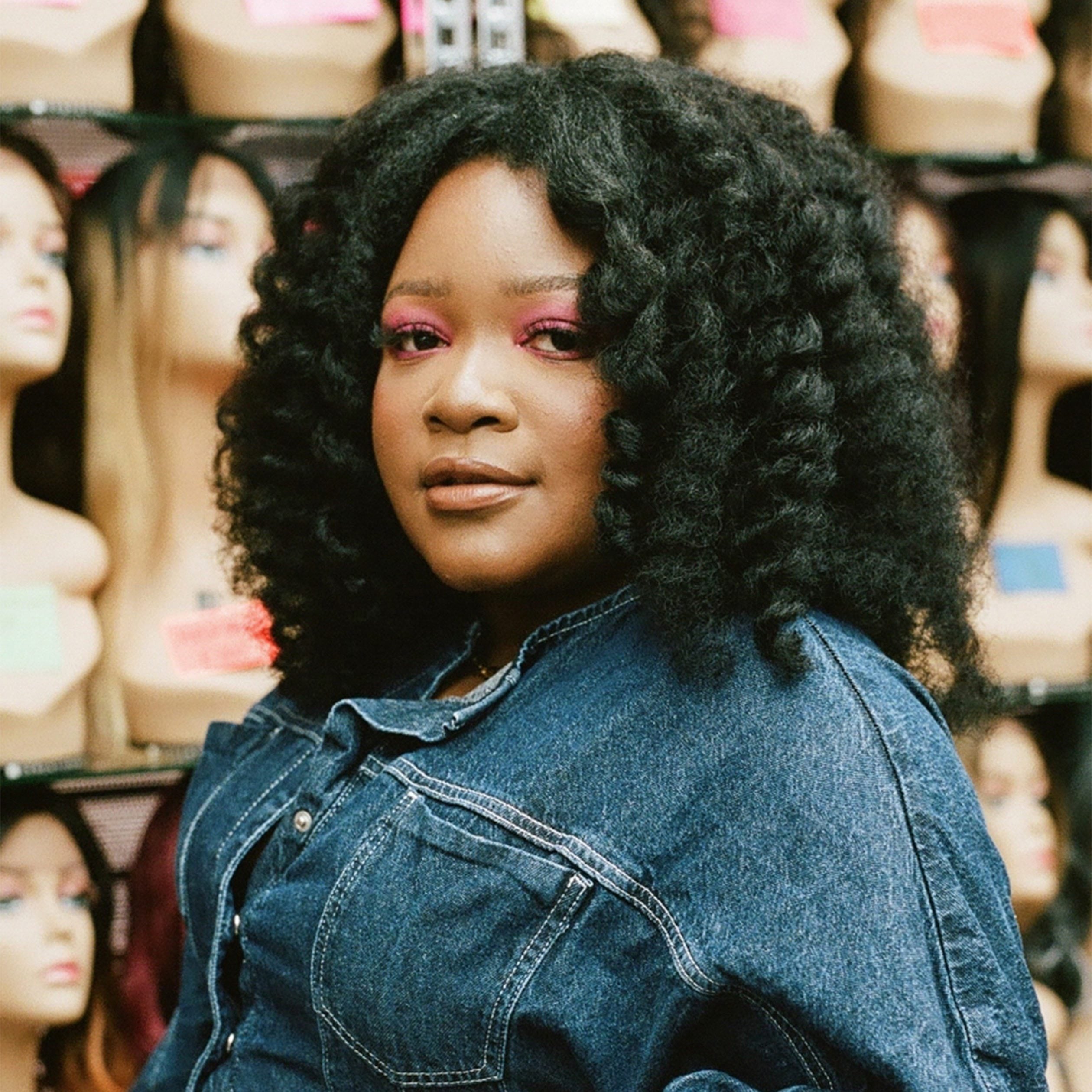
Varaidzo Tendai Moyo, by way of LSE and Bain.
Moyo, 31, founded Ruka in September 2020 after a year at Bain & Company in London as an associate consultant. She read Business Mathematics & Statistics at the London School of Economics, graduating in 2019. Since June 2025 she has also served on the advisory board of the British Beauty Council, an industry-level seat that signals the UK beauty trade is taking a founder seriously. Her co-founder, Ugorji Agbai, is chief strategy officer.
The decision to leave a consulting partner-track at Bain to start a brand was, by the chronology, not a casual one. Ruka was incorporated in October 2020, weeks after Moyo's last month at Bain, and ran for nearly a year of product development before its commercial launch in May 2021. The standard high-achiever ascent inside management consulting is the path Moyo declined. The standard founder pivot, into something that builds slowly off a category insight rather than a hype cycle, is the path she took.
The investors around the table
The new round brings Henkel Ventures and Freedom Trail Capital (via its FT 1804 Fund I vehicle) onto the register alongside Ruka's existing institutional backers: Backed VC, whose founding partner Alexander Brunicki has sat on the board since at least early 2024, and Big Issue Invest, the social-impact lender. The angel roster around the round is unusually well-chosen: Olympic medallist Dina Asher-Smith, former McKinsey senior partner Knut Alicke, retail and M&A operator Sophia Dennis, and Vital Versatility founder Didier Morais. Existing angels at the company include the AI investor Ian Hogarth (current chair of the UK's AI Safety Institute) and Tristan Walker, founder of Walker & Co. and now a P&G operator.
Moyo, in comments to The Business of Beauty on 13 May, framed the difficulty of putting that mix together herself. The Henkel cheque, in that light, is partly a vote of confidence in the cross-category proposition and partly the resolution of a real fundraising problem.
Read at one remove, this is also a story about Zimbabwean diaspora capital-formation. The cohort of Zimbabwean-founded businesses scaling out of London, Johannesburg, New York and Toronto has, in the last five years, started to clear the kind of cap-table milestones that were once the preserve of much better-networked founder communities. Ruka is the most legible example to date.
What the public accounts show
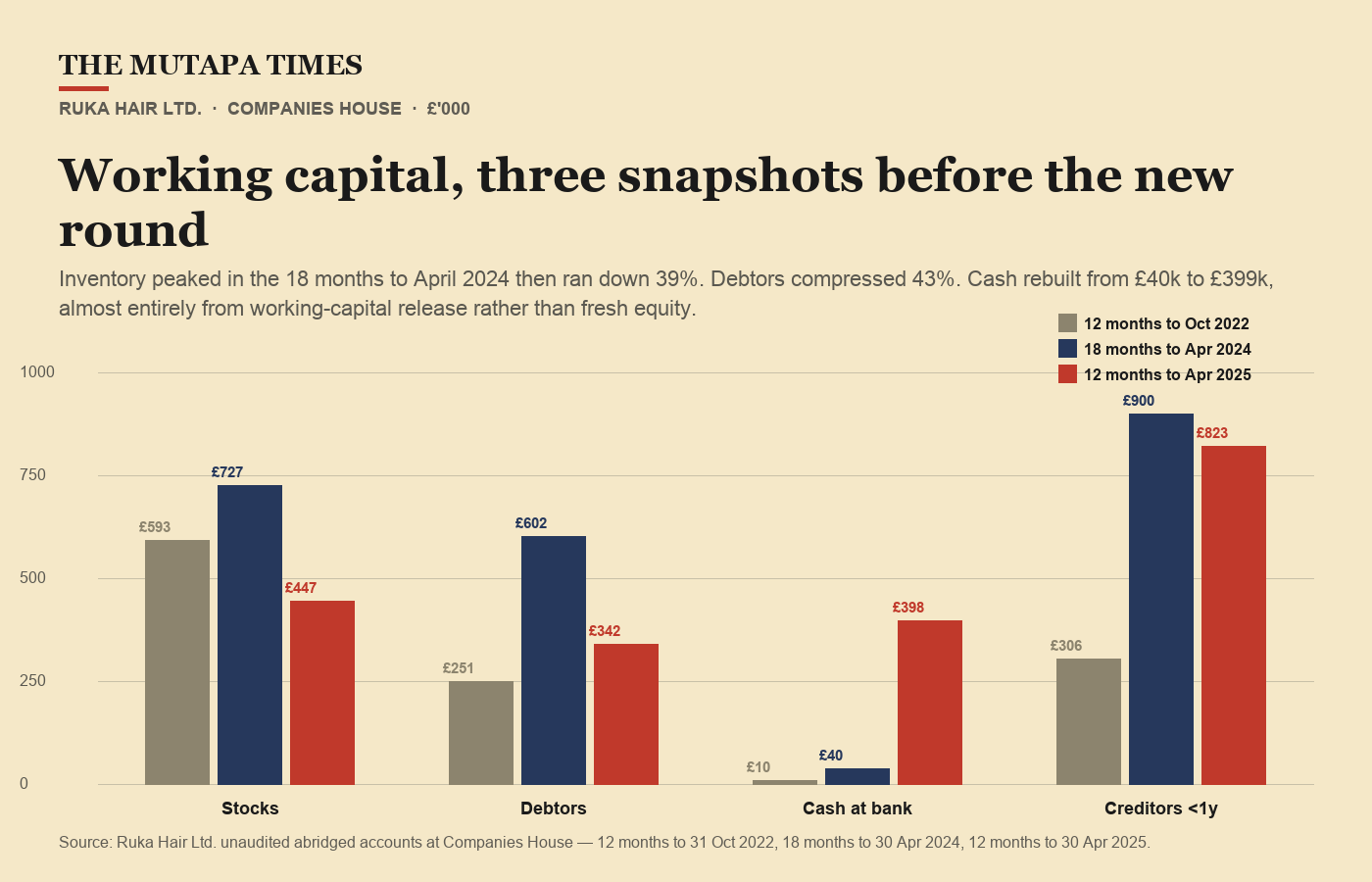
Ruka filed three sets of accounts at Companies House over the period from October 2022 to April 2025. Across those snapshots, the company tightened its working-capital cycle in the most recent twelve months: stocks ran down 39%, debtors compressed 43%, and cash at bank multiplied nearly tenfold from £40k to £399k, almost entirely from working-capital release rather than fresh equity. For a DTC consumer brand operating through the 2024 funding winter, this is the disciplined version of survival.
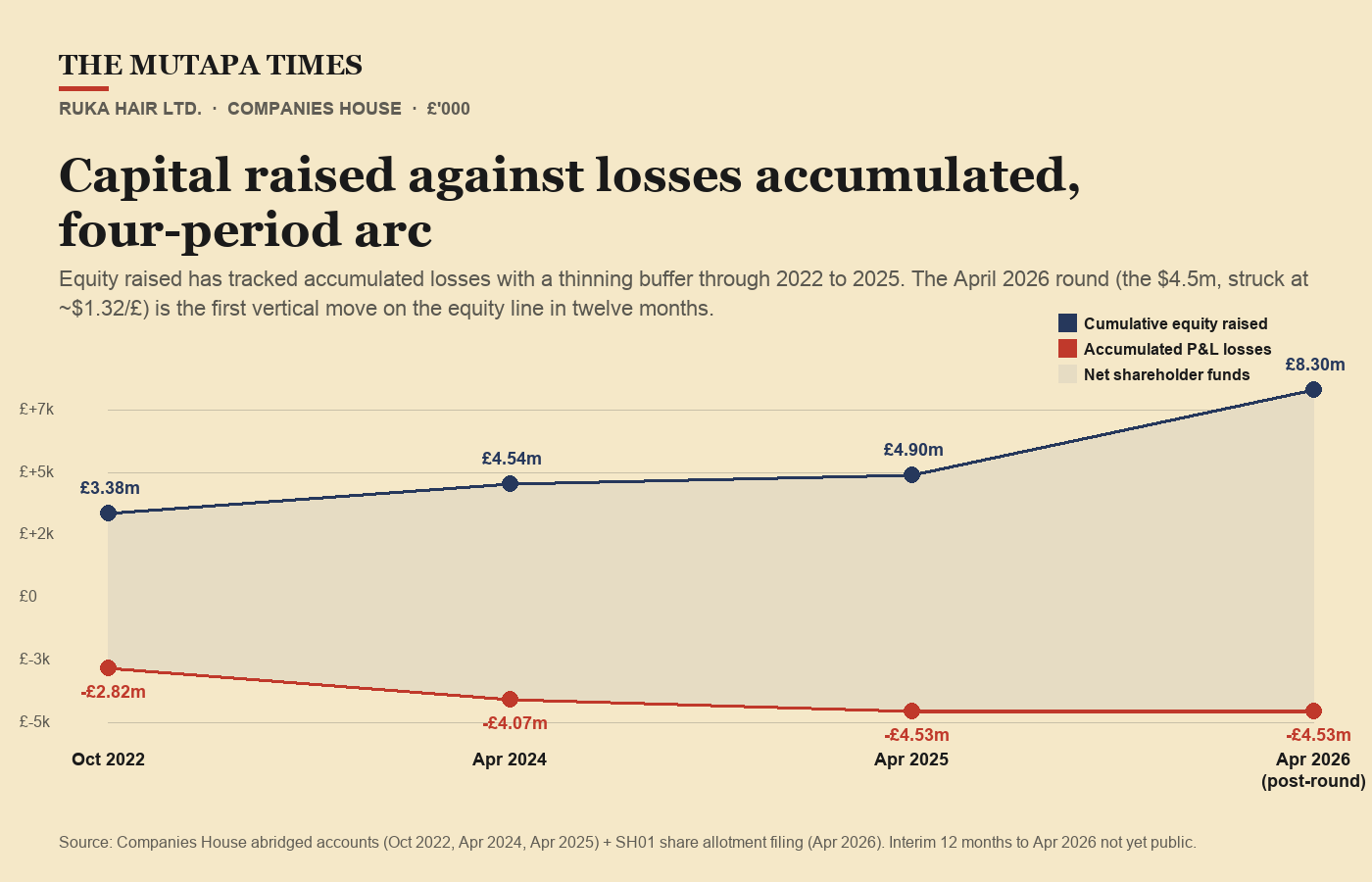
The accumulated profit and loss deficit tells the complementary story. Cumulative losses widened from £2.82m at October 2022 to £4.53m at April 2025, but the annualised burn rate fell from roughly £826k across the 18 months to April 2024 to roughly £463k in the year to April 2025. The annualised burn has roughly halved. The new round, twelve months later, lifts net shareholder funds from £368k to roughly £3.8m on an implied post-money basis.
A consumer-demand arc to set against the financial one
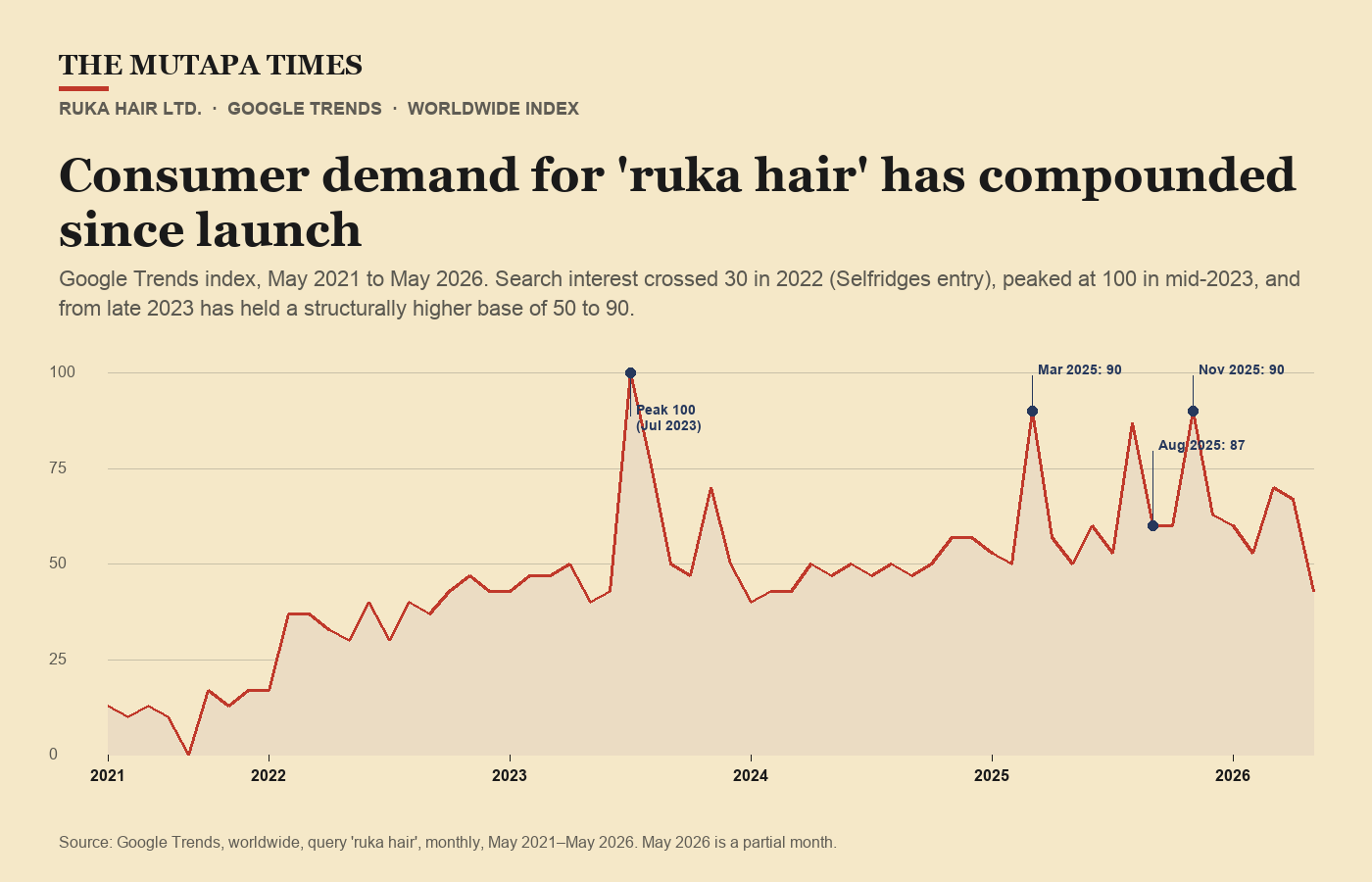
What the balance sheet does not show is consumer pull. Google Trends, indexing the relative volume of "ruka hair" searches over the past five years, tells that story. Search interest sits in the low teens at launch in mid-2021, crosses the index-30 threshold in early 2022 (the year Ruka entered Selfridges), peaks at 100 in July 2023, and from late 2023 settles at a structurally higher base of 50 to 90. "Ruka hair perfume" and "hair perfume" both register as breakout queries in the past year, independent corroboration of management's stated bestseller line.
Read alongside the working-capital discipline of the most recent reporting year, this is a brand whose demand-side has compounded against its operational tightening, which is the more durable combination. Plenty of DTC brands have cut costs into a stable revenue base. Fewer have cut costs into a still-growing consumer audience.
The product bet
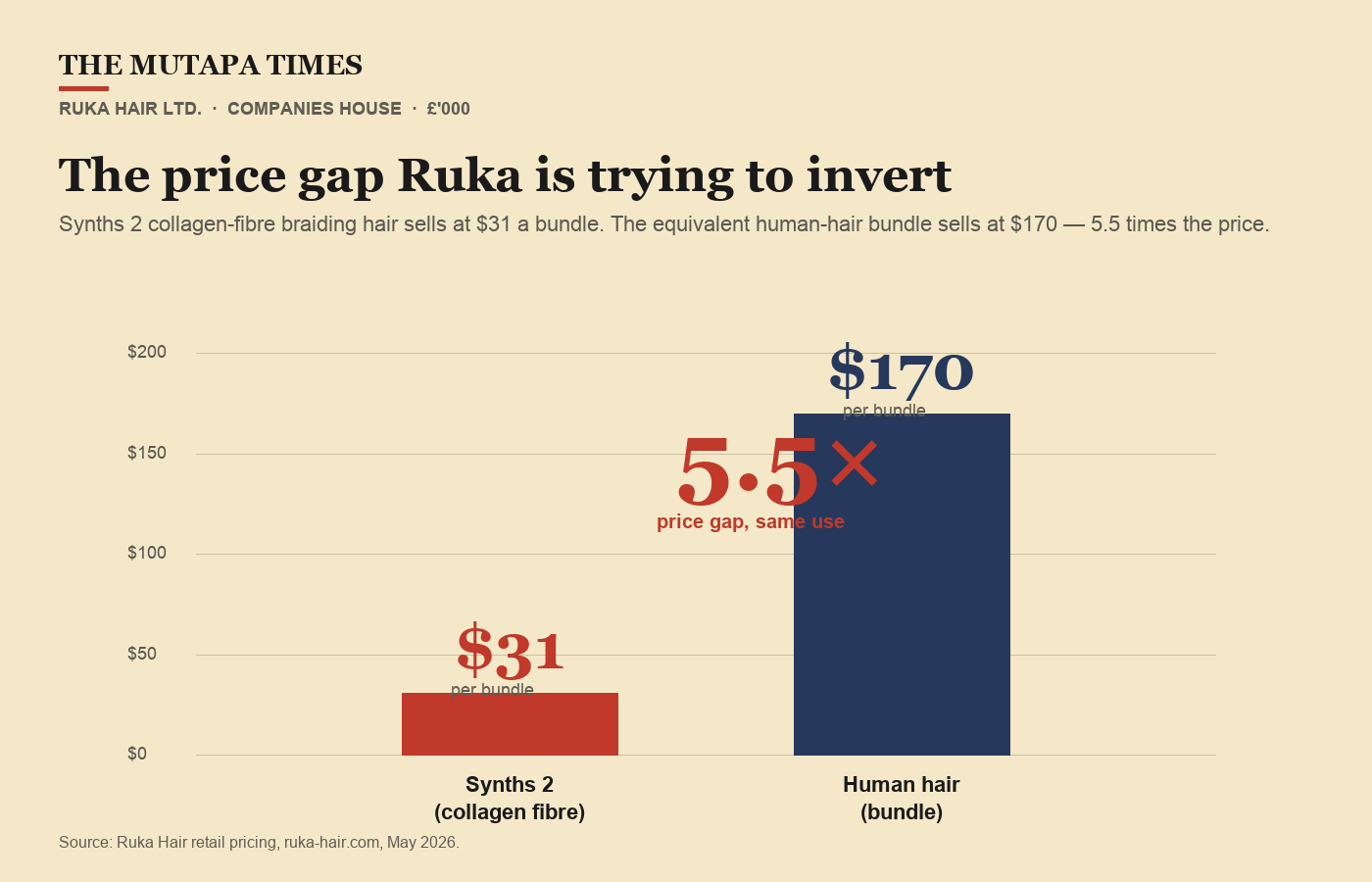
The cleanest investment thesis here is biotech. Ruka's Synths 2, launched in 2024, is a braiding fibre made from collagen protein produced in Japan, sold at $31 a bundle against $170 for the equivalent human-hair product. The price gap is large enough on its own to be commercially interesting. The bigger bet is on substitution rather than discount.
Moyo, in an interview with Beauty Independent published alongside the funding announcement, said she wants to "eradicate human hair out of the whole ecosystem," language that positions the company explicitly against the global human-hair supply chain, an opaque trade dominated by collection networks across South and South-East Asia.
A 2025 patent filing covers Synths 3, due in the first quarter of 2027, which introduces shape-memory technology allowing the fibre to be straightened or curled before reverting to its original texture on wash. If the science holds at scale, Synths 3 makes the human-hair market optional, rather than necessary, for a meaningful segment of the consumer base.
Moyo described the vision to Beauty Independent in the well-rehearsed manner of a founder who has done the round: "We call ourselves the Apple of haircare because we want to create this ecosystem of textured hair products that are led by science and innovation." The Apple comparison is doing real work in the pitch. Whether it lands at the next valuation milestone will depend on whether Synths 3 delivers laboratory results in the field.
Hair perfume, a smaller adjacent line, is Ruka's second-best-selling category after extensions. The business-to-business arm, at 14% of revenue, supplies wigs and extensions to the National Theatre and to stylists working on Netflix and Apple TV+ productions. Brand partnerships include a sweat-wicking-headband collaboration with Gymshark and the forthcoming Schwarzkopf Osis curl spray. Ruka was honoured at The Business of Fashion Global Beauty Forum in 2025, an early industry marker that the brand was being taken seriously by the people who allocate beauty capital.
The geography of the customer
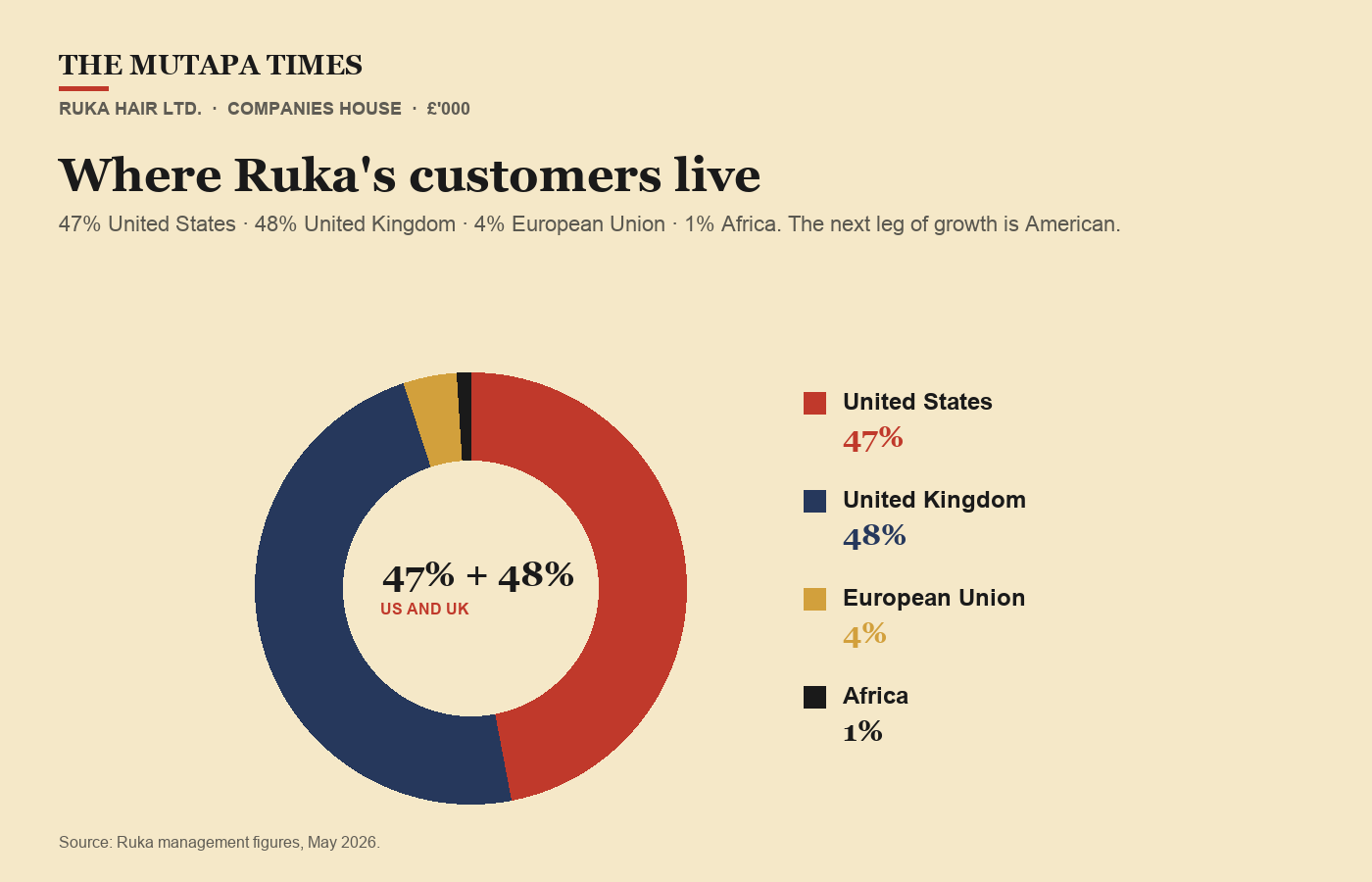
Ruka's customer base is split almost evenly between the United States (47%) and the United Kingdom (48%), with Europe at 4% and Africa at 1%. The company entered Selfridges in 2022 and will expand into an undisclosed US retailer in late June. A new East Coast warehouse, opened the week before the round closed, supports the US push and is forecast by management to underwrite a 101% increase in revenue by April 2027.
The mix matters. The proximate growth thesis is American, and the round is being deployed largely in support of that. But the heritage on which Ruka leans is not decoration. The brand's framing, from the Bantu-knots origin story to the Zimbabwean ownership of the founding team, is the bedrock on which the British and American books are being built. African heritage and an American customer base are not at odds here. They are the proposition.

"A good outcome is having enough capital to make this a category-defining brand. That means being around."
The Henkel cheque inevitably reframes the question of what happens at the end. Moyo, in her interview with Beauty Independent, declines to draw a firm conclusion.
She has not, she said, decided whether the answer is a sale. The company's articles, in any case, commit it to a "Primary Social Objective" of high-quality cosmetic products with material positive social and environmental impact, a binding provision attributable to Big Issue Invest's seat on the cap table.
Either way, what stands today is this: a Zimbabwean-founded company running a category-redefining bet from London, with the German group that just bought Olaplex sitting on its cap table, a biotech product line about to ship, working capital tightened and consumer demand compounding, and a community of diaspora consumers, operators and angels with skin in the result. It is the kind of marker that Zimbabwean diaspora founders have not had many of. The next two years will tell us how big a marker. It is already large enough to take seriously.