The Zimbabwean springstone sculpture movement of the mid-twentieth century is, for better and for worse, the art-historical reference point that anyone speaking to a Western audience about Zimbabwean visual culture is expected to start from. It has its canon. It has its market. It has, at this point, its share of caricature and its long tail of compromised production. To be a Zimbabwean sculptor in 2026 is to inherit this lineage and to have to take a position on it, and the most interesting positions, on the evidence of the last several years, have come from artists who refuse the binary of preservation or rejection.
Gideon Gomo is one of these artists. Born in Harare in 1983, trained at the National Gallery of Zimbabwe Visual Art Studio in the 2000s, Gomo has built his practice around springstone, the dense, fine-grained material that anchors the country's sculpture tradition, while pushing it into conversation with metal, copper sheet, found objects, and the bureaucratic detritus of the contemporary state. His earlier work was anchored in stone, with metal as an accessory. The body of work he has brought to Venice is something different. It is anchored in bronze.
A trip to Burkina Faso
Gomo gives a precise origin point for the material shift. In late 2025 he travelled to Burkina Faso for a residency tied to the BISO biennial in Ouagadougou. He went encountering bronze casting as a working tradition, bronze in Burkina Faso has a deep, continuous lineage, with workshops that have been producing in the lost-wax technique for generations, and came back to Harare determined to take the medium seriously in his own practice.
This is the kind of biographical detail that critics sometimes flag and then move on from. We want to dwell on it for a moment. The art world has a habit, when narrating a southern African sculptor's adoption of bronze, of treating bronze as the colonial European medium that the African artist has now ascended to. It is precisely backwards. Bronze in West Africa is older than its European equivalent. The Ife and Benin bronzes, the Akan goldweights, the brass castings of the wider Sahel, these are the deeper tradition into which Gomo has entered. The Burkinabé workshops are the carriers of it, and the residency was the door.
This matters because it reframes the trajectory the Venice rooms are documenting. Gomo has not abandoned the Zimbabwean stone tradition for the European bronze one. He has set a southern African sculpture tradition in conversation with a West African one, and is allowing the two to teach each other. The bronzes in the pavilion are not the artist arriving somewhere new. They are the artist participating in a longer, geographically wider conversation that the curatorial framing of manyonga, confluence, where currents meet, names precisely.
The number plates
The other material decision in the room is the use of discarded vehicle number plates. Weathered, oxidised, stamped with the bureaucratic typography of the Zimbabwean transport ministry, these fragments hang and project from several of the works, most directly from Grief is just Love that has nowhere else to go, where number plates, coins, bronze, and springstone are brought into a single assemblage.
The number plate is a richly loaded material. It carries the imprint of the modern state, the act of registration, the assignment of identity, the moment at which a free-moving object becomes a tracked one. It also carries the marks of its actual life: dents from collisions, sun-fade, the slow chemistry of weather. When Gomo reorders these fragments into the sculptural composition, he is performing a small but very real act of recoding. The plates lose their administrative function. They take on instead a rhythmic, almost calligraphic function, becoming the carriers of a different kind of inscription, one that records movement, repair, and the wear of use rather than ownership.
The juxtaposition with bronze is the central operation. Bronze is, traditionally, the material of permanence; number plates are the material of circulation. Putting them in the same composition stages a conversation between two languages of inscription. Permanence becomes provisional. Circulation gets monumental. The result, in Gomo's words to the catalogue, is the fusion of both worlds.
What stone taught the bronze
Asked, in the catalogue, whether bronze had changed the way he thinks about form, Gomo gives a careful answer. Not exactly, he says. I feel it has improved my perspective to form in a more fluid form hence reverting to adding which is different from stone carving that requires subtraction. The remark is technical, but its implications are large. Stone carving is a subtractive discipline; the form is found by removing what does not belong. Bronze is additive; the form is built up, in wax, by the deliberate accumulation of mass.
Gomo's bronzes carry the discipline of subtraction even though they were made additively. The forms are pared and economical. They do not have the overworked surfaces that bronze often acquires when the sculptor is enjoying the freedom of the medium. They have, instead, the tightness of an artist who came up making decisions in stone and has carried those decisions across into a new material. The result is a body of work that is recognisably contemporary southern African and unmistakably in conversation with the deeper continental sculpture tradition.
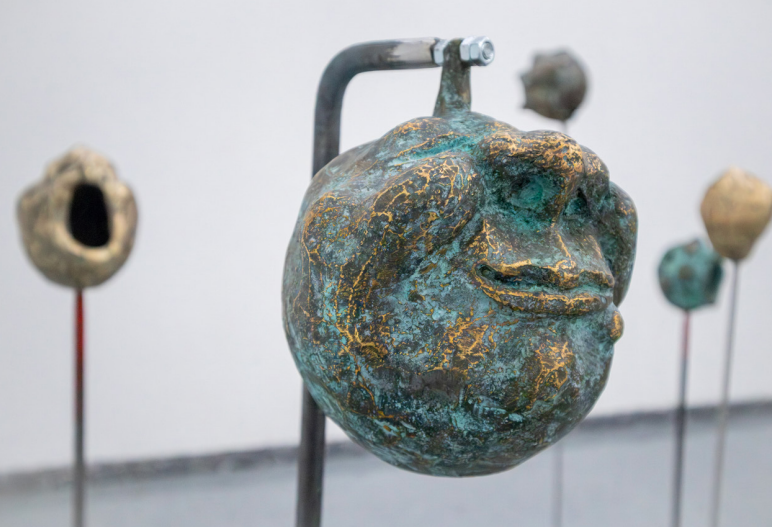
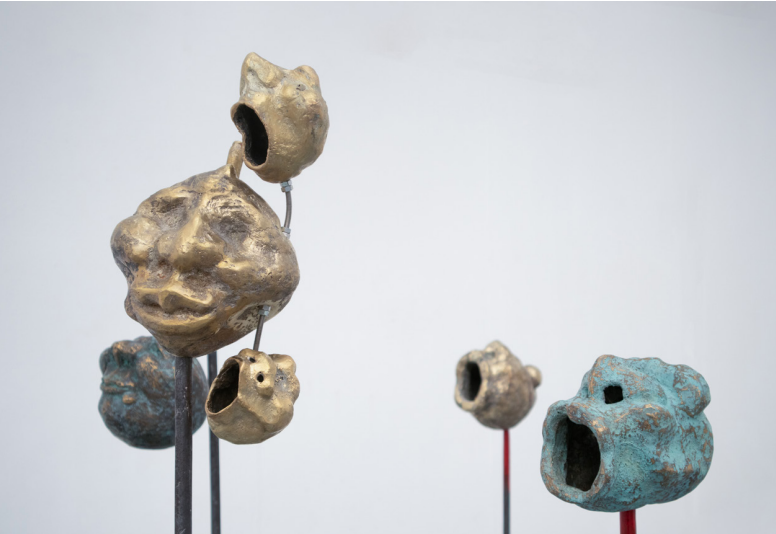
The rhythmic structuring is the signature. Undulating surfaces, repeated forms, and incised gestures evoke movement and continuity, as though the sculptures are animated by an internal pulse, the catalogue notes. We watched the Audience of One installation for a long time on the opening evening. The piece is a hanging arrangement of cast bronze heads, suspended at varying heights from steel plates. The air movement in the nave is enough to keep the heads in very slight oscillation, and the cumulative effect is choral, a small congregation of forms breathing on their own time.
The Venice rooms are the most consequential statement Gomo has yet made of what his practice will be in its second half.
Sculptors who emerge from established national traditions tend to face a particular kind of mid-career decision: whether to consolidate inside the tradition or to extend it. Consolidation is the safer move. Extension is harder, riskier, and frequently misread. Gomo has made the extension move. The Venice rooms are the most consequential statement he has yet made of what his practice will be in its second half.
The decision is not a rejection. The pavilion includes works in which Zimbabwean springstone remains the central material, Grief is just Love that has nowhere else to go is the most intimate of these, and the bronze pieces are clearly the work of a sculptor whose hand was trained in stone. What has changed is the field of conversation. Gomo is no longer producing work that needs to be read against the Zimbabwean tradition alone. He has staged a conversation that runs from Great Zimbabwe to Ouagadougou and back through Harare to Venice, and the conversation is the work.
This is also, we think, the proposition the curatorial frame of the pavilion is most directly testing. The catalogue argues that the brain reorganises itself in response to change; that cultures, by extension, can too. Gomo's room is the most direct argument the pavilion makes for that thesis. The reorganisation, in his case, is happening at the level of materials.
On rhythm, on memory, on what does not get cast
There is one further note, which we offer tentatively. The bronzes in the pavilion are not, with one or two exceptions, monumental. They are intimate. The heads in Audience of One sit somewhere between the size of a fist and the size of an actual head. The found-object assemblages are at the scale of small altarpieces. The rhythm of the work is closer to that of a domestic shrine than that of a public monument.
We take this to be deliberate, and to be part of what Gomo is doing with the inherited language of bronze. Monumentality is the colonial bronze tradition's most familiar mode; the freestanding civic statue, the imperial portrait, the equestrian general. Gomo has cast in the same metal and has produced work that operates in a mode entirely different from this. The bronzes here are at the scale at which one can sustain a sustained, single-person relationship with them. They are not the property of the public square. They are the property of a more private attentiveness.
In the pavilion's broader conversation, Raath's quilted surfaces, Shumba's slow charcoal, Dzingai's pan-African studio compositions, Mapondera's vessels of contained memory, Gomo's intimately-scaled bronzes carry their part of the argument. The pavilion's case for adaptation as a creative act, rather than as a wound, is made in five different materials. Bronze is the one that carries the longest historical baggage. Gomo has unburdened it.
What to read next
Gideon Gomo is represented internationally and has held residencies at Gasworks in London and the G.A.S. Foundation in Lagos. His next solo show is scheduled at Tiwani Contemporary in Lagos in 2027.
This is the fourth in a five-part series on the Pavilion of Zimbabwe at the 61st Venice Biennale. Previous: Eva Raath, Felix Shumba, Franklyn Dzingai. Final piece this week: Pardon Mapondera: gone but not forgotten. All quoted artist material is drawn from the pavilion's catalogue, published by the National Gallery of Zimbabwe and distributed at the vernissage.