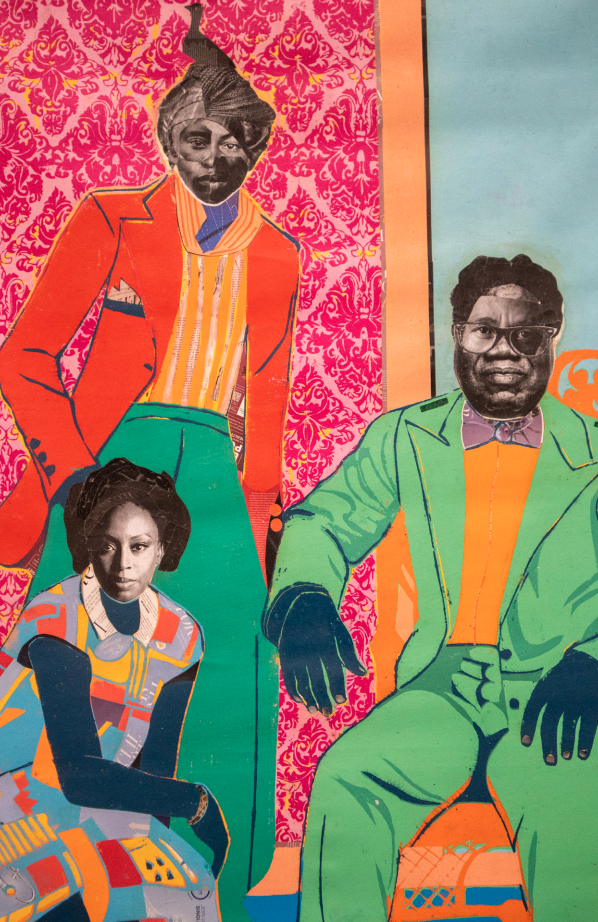
Franklyn Dzingai's room is the room you walk into and slow down. The prints, five large-format works, ranging from 153 × 164 cm to 226 × 160 cm, are immediately legible at a colour level: hot pinks, electric blues, dense ornamental fields, every surface working. But the legibility at first glance is a kind of feint. The actual labour of looking at a Dzingai print begins about twenty seconds in, when the viewer notices that the figures occupying each composition have been assembled out of photographic faces, actual photographic faces, mostly Black, mostly from the mid-twentieth-century studio archive of southern Africa, and that those faces are not the faces of the people whose bodies they appear to inhabit. The collage logic of the work is precise. It takes a few more minutes to begin to read what it is doing.
What it is doing, in summary, is treating memory as a public utility. The faces in Dzingai's compositions are drawn from his family album, a Zimbabwean family album that runs from the 1960s to the 1990s, and from a wider pan-African archive of studio portraiture that, as Dzingai notes in his catalogue interview, looks broadly the same across the continent and across the diaspora in that period. The same flower-and-stool, the same boombox, the same posture. He is not interested in any one of these images individually. He is interested in how they form, when laid over one another, a kind of neural commons: a shared visual vocabulary of how Black families staged themselves for the camera, before the smartphone made the staging private and continuous.
The reductive cardboard print
Dzingai, born in Kwekwe in 1988, trained at the National Gallery of Zimbabwe Visual Art Studio in Harare, is, by his own account, one of the very few artists in Zimbabwe today who works primarily in printmaking. Within printmaking, his preferred method is the reductive cardboard relief print. The technique is unforgiving. The artist carves into a sheet of cardboard, prints a layer of colour, and then carves away more of the cardboard for the next layer; once a portion of the cardboard has been removed, there is no recovering it. The image is built up by destruction. The decisions cannot be reversed.
This matters because the formal density of Dzingai's compositions, the strong outlines, the blazing fields of flat colour, the patterns that read as wallpaper at distance and as carefully built grids up close, is doing real conceptual work. It is the visual analogue of the irrevocability of memory itself. What is laid down stays. What is removed cannot be put back. The compositions have the structure of recollection: every later addition has to negotiate with what has already been committed to the surface.
The pose, repeated across geographies
One of the discoveries of looking at Dzingai's work, and one of the points he makes most directly in his catalogue conversation, is that the studio portrait of the late twentieth century is a remarkably standardised genre across the African world. The pose taken in Zimbabwe is, give or take, the pose taken in South Africa, in Ghana, in Mali, in the Black studios of New York and London and Atlanta. The flowers, the stool, the boombox, the radio, the old TV, the can of beans. The pose is just the same, Dzingai says. He spent time looking at studios across the period on the internet, comparing the staging, and found himself unable to tell the geographies apart.
This is the underlying argument the prints are making, even at their most ornamental. Black family-photographic culture in the second half of the twentieth century constituted a transcontinental visual language, exchanged through circulation of magazines and album-mailings and migration patterns and the simple fact that the studio photographers were trained by other studio photographers. The compositions Dzingai is constructing are not local. They are pan-Black, in a way that the global art market is still figuring out how to talk about.
The faces in any single composition come from many different family albums. The body the face has been collaged onto wears a colour scheme imagined from Dzingai's own translation of the originally black-and-white image. The wallpaper behind the figure has been carved into the cardboard from a pattern recalled from a particular kitchen, or a particular dressmaker's lining, or a tilework from a postcard that was once in a magazine. The works are dense in the way memory is dense, saturated with referents from sources that the viewer recognises faintly without quite being able to place.
What is held back
There is a quality of withholding in Dzingai's prints that is easy to miss on first viewing. The figures rarely make eye contact with the viewer. When they do, the contact is partial, one eye visible, the other turned slightly away, and the expression refuses to settle into anything that can be paraphrased. The compositions stage real moments, in Dzingai's phrase, but they decline to disclose what those moments mean.
This is intentional. I want to give room for interpretation, he says in the catalogue. I just don't want my story to be just their story also. What we found, on second visit, was that the withholding is precisely what makes the work hospitable. The prints invite the viewer in by leaving spaces unwritten. The narrative arc, the emotional resolution, the moral of the staged scene, none of these are provided. What is provided is the structure of a felt familiarity, into which the viewer is allowed to bring their own content.
This is, again, the curatorial frame of the pavilion playing out in a particular way. Neuroplasticity, as the catalogue glosses it, names the brain's ability to reorganise itself by forming new neural connections throughout life. Dzingai's compositions are interfaces for this kind of reorganisation. They look, on first encounter, like recognisable scenes. They turn, on sustained looking, into structures the viewer's own memory rewires itself around.
The scale of the gesture, in Venice
Dzingai is also working bigger here than he has before. The largest works in the room, Circuit of Comfort, Vibrant Transmission in Musesengwe Studio, Woven Histories (Diptych), are at the upper end of what is physically possible with the reductive cardboard method, and they are at a scale that is, by the artist's own account, a deliberate response to the Venetian rooms. I just wanted to challenge myself to work on a bigger space, he says in the catalogue, like the Venice of the big walls. I just want people to feel the work rather than the empty space.
This is the kind of remark that can sound like courtesy in a press interview and that turns out, on examination, to be precisely correct. The Pietà rooms are tall and the side walls are long; smaller works would not have held them. Dzingai's prints do. They occupy the architecture without being overwhelmed by it, and they convert the long European wall, historically a space designed for fresco and altarpiece, into a working surface for an entirely different visual tradition. This is its own quiet act of reclamation.
What to read next
Franklyn Dzingai won the inaugural artHARARE Africa First Art Prize in 2021. He has exhibited across Africa, Europe, and Asia and remains one of the most distinctive voices in Zimbabwean contemporary printmaking.
This is the third in a five-part series on the Pavilion of Zimbabwe at the 61st Venice Biennale. Previous: Eva Raath and Felix Shumba. Coming this week: Gideon Gomo, Pardon Mapondera. All quoted artist material is drawn from the pavilion's catalogue, published by the National Gallery of Zimbabwe and distributed at the vernissage.