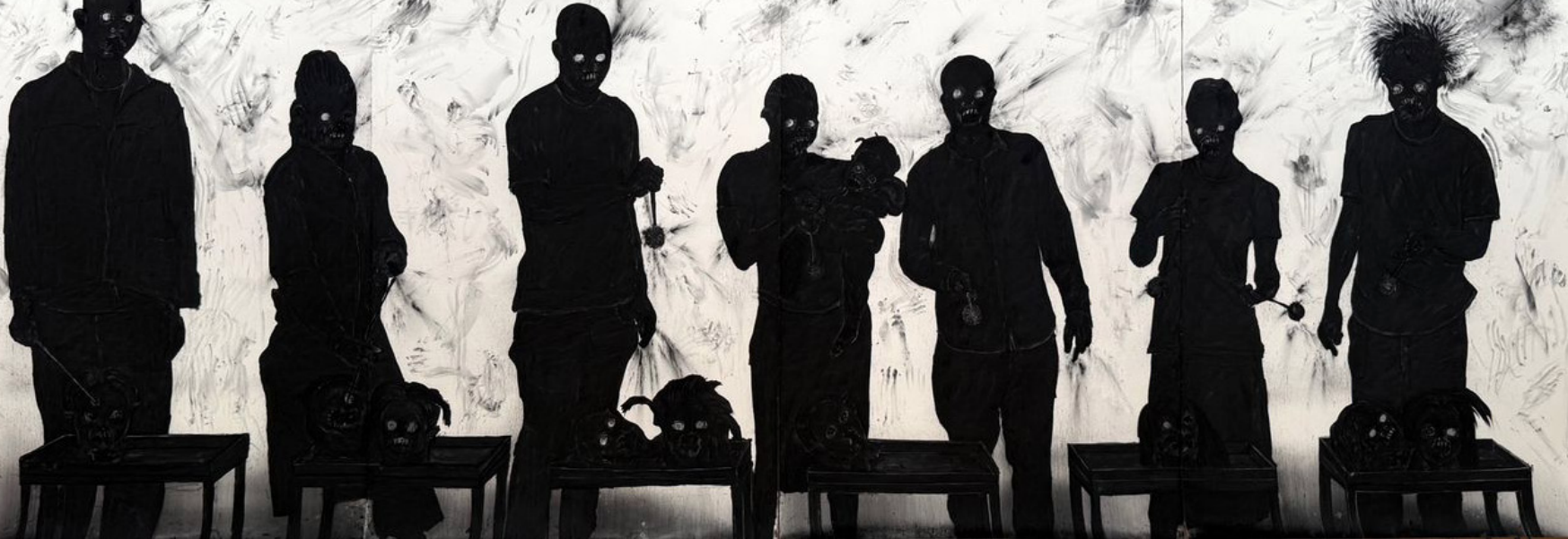
A six-metre charcoal wall is a different proposition from a painting. The first thing it asks of you is the question of how far back you can stand without losing it; the second is how close you can get without disturbing it. Felix Shumba's Wheel-telegram-east-window-line 145XV7-lower, the title is a coordinate, of a kind, in a private system he has been building for the better part of a decade, runs the full length of the north-east wall of Santa Maria della Pietà and refuses to release the eye for the duration of the gallery visit. We stood in front of it on three separate days. It was different each time, and we were not sure on the third occasion whether the work had changed or our adjustment to it had.
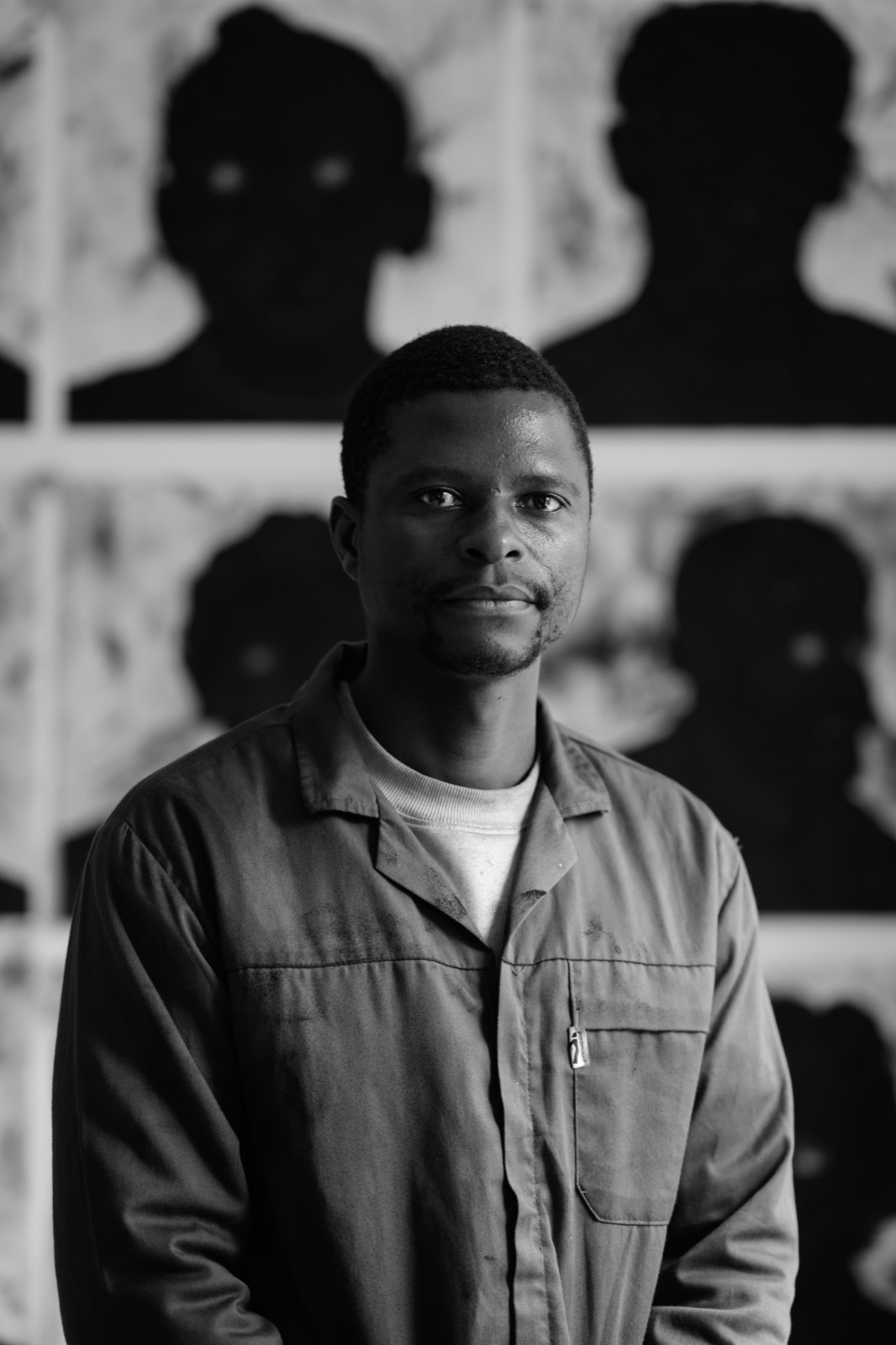
This is the proposition Shumba has been developing through what he calls Fold Field Space: an imagined world structured by a grammar of violence and spectrality, populated by figures in states of masking and unmasking, drawn and erased and drawn again. Shumba, born in Bulawayo in 1989, working today out of a studio in the shadow of Great Zimbabwe in Masvingo, is one of the few contemporary artists working in southern Africa today who treats drawing not as a preparatory medium but as a record of an entire metaphysical condition. The condition is, broadly, the condition of inheriting a history that has not yet finished happening.
What charcoal allows
Shumba is not painting. He is not, strictly speaking, drawing either, not in the academic sense in which drawing is a contained act on a sheet of paper. He is layering charcoal onto archival paper at a density that approaches the sculptural, and he is doing it with charcoal he has made himself, from raw materials, in a process closer to alchemy than to the art-shop transaction the word charcoal usually evokes.
The choice of medium is loaded. Shumba is direct about this. Charcoal does not require tools for its application, he says in his catalogue interview. Unlike painting, which depends on brushes and preliminary processes such as mixing paint and solvents, charcoal is held directly in the hand. That immediacy allows me to translate what I feel is necessary on paper. The immediacy matters because what he feels is necessary is, at root, a state of attention to disappearance, and disappearance is a slow medium that does not survive translation through an apparatus.
The works on view are remarkably unstable surfaces. They are densely worked, almost three-dimensional in their accumulation of pigment, but they are also, by the laws of the medium, in continuous slow conversation with the environment around them. Charcoal moves. Watercolour paper, when affected by atmospheric moisture, swells and contracts. The drawings will be subtly different at the close of the Biennale's seven-month run than they were on opening night. Shumba knows this. He is interested in it.
Fold Field Space
It is worth pausing on Shumba's term for the world his figures occupy. Fold Field Space, abbreviated FFS in his notebooks and increasingly in the critical writing around him, is not, Shumba insists, a metaphor. It is a place. It has its own physics. It is haunted in a structural sense, by which Shumba means that the violence inscribed on it does not disperse over time but folds inward, fields into fields, accumulating in pockets that the drawings reveal in flashes.
The figures who populate FFS are recognisably human and unmistakably not at peace. They wear masks, both the literal protective covering of the COVID-19 years and the symbolic mask of the security apparatus, and they hold objects that occupy an uncertain space between tool and instrument of harm. Shumba's research, as he describes it, is largely conducted away from official archives. He listens. He goes to bus terminals, to places of worship, to hospitals; he speaks with makorokoza, informal small-scale gold miners, and with survivors of the liberation war and the years that followed. The drawings emerge from this listening, not from any institutional record of it.
This matters because it positions Shumba's practice as a counter-archive. The official histories of colonial and postcolonial Zimbabwe, Shumba is clear, are partial. They have been edited at every turn by the people who controlled the means of editing. What Shumba is producing on the wall at Santa Maria della Pietà is, in part, the work of insisting that other histories survived alongside those official ones, in bodies and gestures and the way an older man holds his hand when he speaks of a thing he saw but was never permitted to record.
The Telephone Reader series
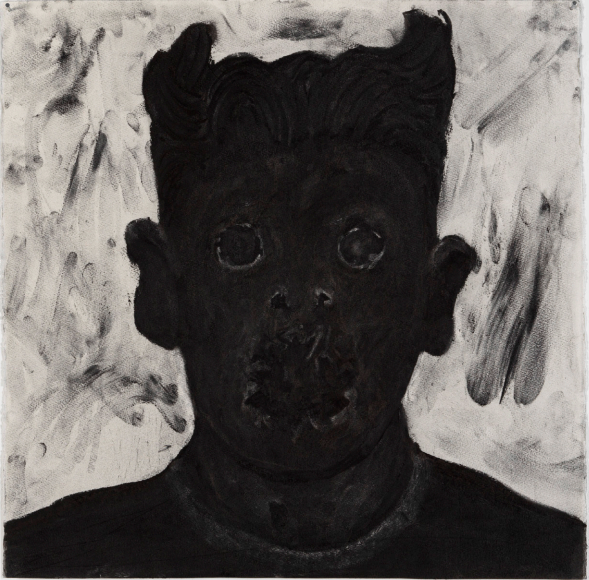
The fifteen square-format drawings that form the Telephone Reader series, hung in a single horizontal band along the opposite wall, are the works the room returns to. Each is the same size (56 × 56 cm). Each shows a figure, hunched, the face occluded by the implied gesture of looking at a small held object. The object itself is never visible. What is visible is the relation of the body to its absence.
The series is, on one reading, a portrait of the contemporary subject, phone-bent, in the slang now used to describe the posture, and on another reading, much darker, a portrait of what becomes of attention when the device it has been directed toward is taken away. What does the body still do, the series asks, when there is nothing left to read? Shumba's answer, in fifteen small accumulating frames, is that the body keeps reading. It has been taught to. It is now, in the most literal sense, its second nature.
The cumulative effect, walking the line of the fifteen works, is not unlike the experience of looking at a frieze. Each panel is a fragment; the meaning is in the rhythm. We watched the rhythm shift between drawings, the slight raising of a shoulder, the changed angle of the head, the figure that appears to have begun to lift its eyes off the absent screen, and felt, by the end of the line, that we had been told something we would not be able to repeat in words. This is what Shumba's drawing does. It conveys at a level that argument cannot reach.
The drawings ask the visitor to occupy the same uncertainty that produced them.
Shumba's surfaces do not stabilise. They are unsettled in a literal sense, charcoal is dispersing very slowly into the air of the room, and in a more important figurative one. There is no clean line between what is visible and what is implied; the figures emerge from their grounds and recede into them with a kind of breathing motion that the visitor is required to attune to.
What this produces, over the duration of a careful visit, is a state of attention that is unfamiliar to most contemporary gallery-going. Modern museum design has spent the last several decades optimising the visitor's experience for legibility and speed: wall texts, sightlines, the steady metabolism of one work after another. Shumba's room resists every part of this optimisation. The drawings withhold. They require you to slow down and to admit that you are not entirely sure what you are looking at.
This, we think, is the curatorial bet of the pavilion playing out in a particular way. To stay present to what is on its way out of sight is itself a discipline, one our era has, in conspicuous ways, lost. Shumba's drawings are a working argument for getting it back.
Mortality, without metaphor
It would be possible, and perhaps customary, to read Shumba's work in this pavilion as work about death. We would push back gently on that reading. Shumba is not making allegories. The mortality that runs through the Telephone Reader series and through Wheel-telegram-east-window-line 145XV7-lower is not the kind that organises a redemption narrative. It is the lived condition of disappearance, of the gradual loss of presence that the medium itself enacts, and that the figures inside it are caught performing.
This is harder to write about than it is to look at. The drawings do not give the writer the consolation of resolved metaphor. They are, instead, in a long quiet negotiation with the fact that things go. People go. Histories go. Even the drawing itself, if you wait long enough, will go. What Shumba has done with the medium of charcoal, a medium so unstable it borders on perverse to use it at this scale, is to give that negotiation a public form.
The pavilion's broader frame of neuroplasticity gets a particular charge in Shumba's rooms. If neuroplasticity is the brain's capacity to reorganise itself in response to change, Shumba's work is the reminder that some of what the brain reorganises around is loss. The rerouting that the curatorial argument celebrates is, in his account, also a kind of grieving. The drawings hold both sides of that, the survival and the absence, without collapsing one into the other.
What to read next
Felix Shumba is represented by Galleria Fonti, Naples, and Corva Mori. He has exhibited at the Sharjah Biennial and at institutions across Europe and Africa. His upcoming residency at the Sharjah Art Foundation continues into 2027.
This is the second in a five-part series on the Pavilion of Zimbabwe at the 61st Venice Biennale. Previous: Eva Raath: a slow archive of stitched memory at Venice. Coming this week: Franklyn Dzingai, Gideon Gomo, Pardon Mapondera. All quoted artist material is drawn from the pavilion's catalogue, published by the National Gallery of Zimbabwe and distributed at the vernissage.