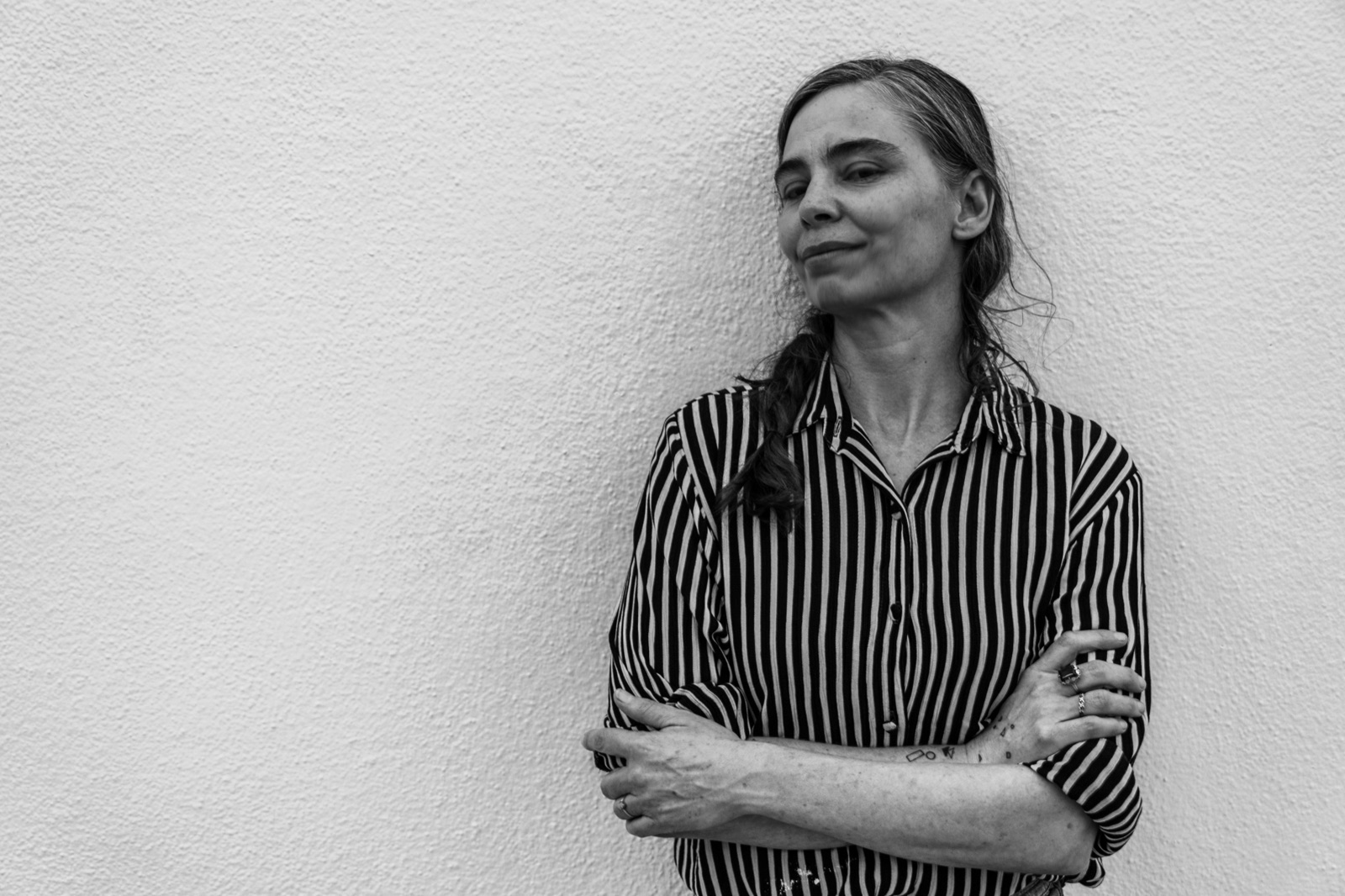
We met Eva Raath's work before we met the artist, which is the right order with most pavilions and the only order with this one. Medusa Menopause, a 7.6-metre length of acrylic-painted paper, hung from a brass rod near the entrance to the southern wing, was the first piece to declare itself in the room, and one of the few that did not need any wall text to do the declaring. We stood in front of it for, by the kindest estimate, fifteen minutes. We came back twice during the week. By the second visit we had decided it was the most underestimated work in the pavilion.
Underestimated is the word, because Raath's contribution has the surface vocabulary of the decorative and the quilted, and the contemporary art world is still in the habit of mistaking decorative for unserious. The mistake here is unusually expensive. What Raath has built, across Medusa Menopause, Memory Quilt, Absence of Memories, Checkered Memories, and the parasol work When Your Brain Doesn't Fit the System, is a working theory of memory as a textile object: assembled from fragments that have already lived their first lives, stitched in patterns that hold and disclose at the same time, subject to ageing and fade and repair on exactly the same terms as the materials themselves.
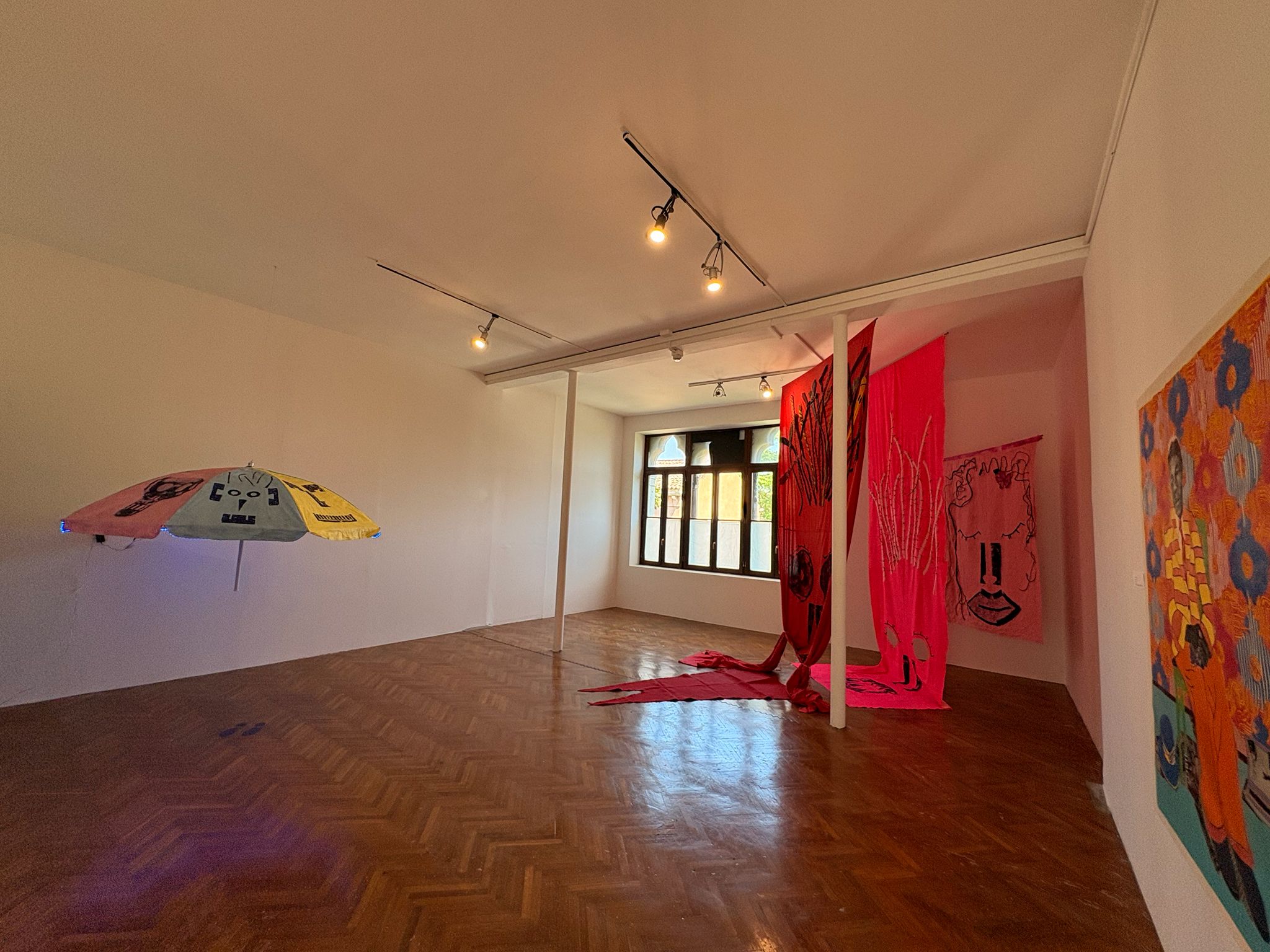
Medusa Menopause, 2025. Acrylic paint and medium on paper. 762 × 228 cm. The largest of Raath's contributions and the first work the visitor encounters on entering the pavilion's southern wing. Courtesy of Eva Raath
The materials are the argument
Born in Harare in 1979, Raath works at the intersection of printmaking and textile, and she works with a discipline of refusal: refusal to buy new when something old will do the work better, refusal to discard, refusal to treat the decorative as anything other than a long-running argument about who is allowed to make beauty and to what end. Her sources, as she explained in conversation, are the surfaces of African daily life: the patterns of the taxi bag, the woven plastic shopping bag used across the continent, the iconography of North African tilework, the granite formations of the Marondera region, and the domestic textiles of her own family.
The materials, in other words, are not the medium of the argument. They are the argument. Memory Quilt is built, in part, from patchwork squares cut by her mother, who was a quilter. Absence of Memories is block-printed onto an enamel dish that her father was bathed in as a child. Checkered Memories is woven together from family photographic slides, physical 35mm slides, whose images can be read only obliquely, in fragments, depending on the light. None of these materials are inert. They have, in Raath's word, history, emotion, and presence. They are not the props of memory; they are memory's physical substrate.
These familiar objects carry memory. They give me a sense of security and comfort. In my practice, I work with existing materials; there is no need to buy anything new. What already exists holds history, emotion, and presence. These materials continually inspire me.
EVA RAATH · TO THE PAVILION OF ZIMBABWE CATALOGUE
A theory of repair
Raath spoke, in the interview reproduced in the pavilion's catalogue, about having grown up in a society where we threw nothing away, it was always repaired and reused. The reference, in the most immediate sense, is to Zimbabwe in the late twentieth century. The reference, more broadly, is to a way of relating to material that the global beauty-supply chain of the early twenty-first has actively erased: a discipline of attentiveness to what already exists, an ethic that prefers the marked and the mended to the freshly-produced.
This is where the work earns its weight. It is easy to make the discussion of repair in contemporary art into a question of sustainability metrics; it is harder, and more useful, to make it a question of attention. Raath's quilted and stitched surfaces argue that the act of tending, her word, is itself a form of cognitive labour. Stitching, sewing, and layering keep memories connected and alive. The process, she says in the catalogue, becomes an act of tending, of preserving, and of quiet repair.
It is hard not to see this, in the context of the pavilion's broader curatorial frame of neuroplasticity, as an embodied response to the brain-science metaphor. The brain reorganises itself by repair. So does the quilt. So does the household. The repaired object is not a compromised version of the new one. It is the thing the new one is, eventually, on its way to becoming, if anyone cares enough to keep it.
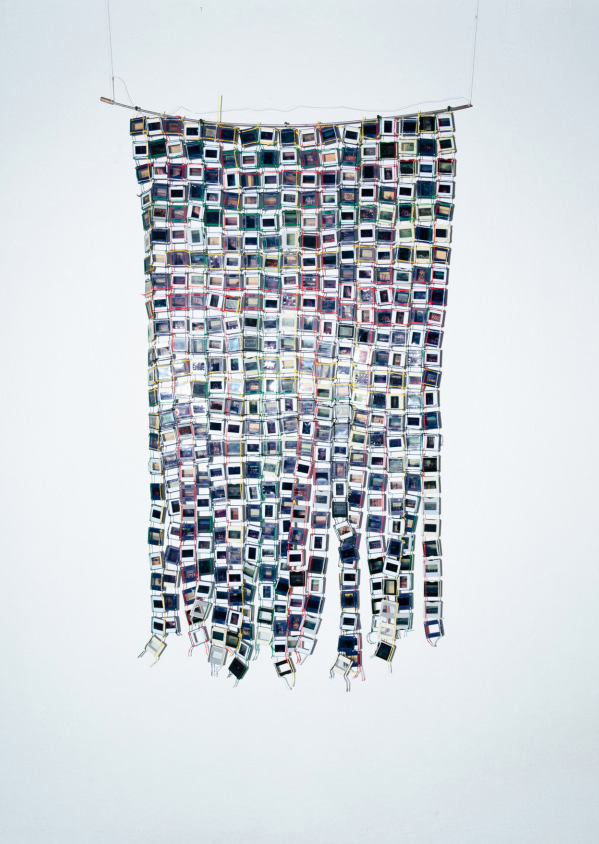
Checkered Memories, 2025. Woven slides. 202 × 110 cm. Family photographic slides, knotted together with coloured thread into a hanging panel that catches and refuses the light by turn. Courtesy of Eva Raath
On colour, on thorns, on the body
The visual surface of the work is, on first encounter, surprisingly bright. Hot pinks, lemon yellows, deep marine blues. The brightness is not decorative; it is, on Raath's account, semantically loaded. A red face expresses heat and rage, she told the catalogue's interviewer. The gradual cooling of colour signals movement toward peace. Sewn-in thorns make the eye flinch even before the brain has caught up. The colour, in other words, is doing the work of an emotional grammar, a way of holding interior weather that does not require language.
The body recurs across the works, but obliquely. Medusa Menopause names the body of the older woman and the cultural reading of her, both literally, in the Greek myth, and metaphorically, in the contemporary stigma around the hormonal passage the title invokes. Raath's piece refuses the myth's terms. The Medusa here is not monstrous; she is simply a body that has been lived in long enough to need new accommodations. The work makes that accommodation visible in the surface itself: the cloth has been crumpled, layered, stitched, and printed over, just as the body the piece names has been weathered, stitched, and printed over by time.
This is gentle work, in the technical sense, it does not raise its voice, but it is also work that does not flinch. The body it stages is the body its viewer is also, in some configuration, on the way to becoming. We watched several visitors stop in front of Medusa Menopause and stand longer than they had intended. The work is doing recognition labour for people who have not, in much contemporary art, been recognised as a subject worth this kind of attention.
My work depicts natural occurrences that shape human life: forming memories in childhood, losing memory as we age, moving through menopause, learning, and change. These processes are universal and inevitable. They can be disruptive, but they can also be transformative and positive. Comfort and disruption coexist; one cannot exist without the other.
EVA RAATH · TO THE PAVILION OF ZIMBABWE CATALOGUE
The slow archive
If we had to name what Raath is offering Venice this year, in a phrase that the visitor will carry out into the fondamenta, it is this: the slow archive. Where most contemporary visual culture archives memory by photographing it and uploading it, fast, frictionless, optimised for distribution, Raath archives memory by stitching it back into the materials it was already inside. Her archive does not scale. It cannot be searched. It has to be visited.
This is also the form Raath's argument takes. Slow time, in the pavilion's vocabulary, is a counter-tempo to acceleration and extraction. Raath's Medusa Menopause is six metres of slow time. Memory Quilt is two square metres of it. Absence of Memories is half that. The pieces are the time they took to make, made visible in the surface; and what they ask the viewer to give back is some equivalent measure of attention.
That ask, in a Biennale year as crowded with spectacle as this one, is a quietly extraordinary one. Raath's contribution is the room that the rest of the pavilion arranges itself around.
What to read next
Eva Raath is represented by Gallery Delta, Harare. Her Memory Quilt and Medusa Menopause will travel from Venice to a still-undisclosed institutional show in 2027.
This is the first in a five-part series on the Pavilion of Zimbabwe at the 61st Venice Biennale. The introductory essay, A week of beauty: Zimbabwe's eighth pavilion at the 61st Venice Biennale, is available on the Mutapa Times site. The next four pieces, on Felix Shumba, Franklyn Dzingai, Gideon Gomo, and Pardon Mapondera, will run through the week. All quoted artist material is drawn from the pavilion's catalogue, published by the National Gallery of Zimbabwe and distributed at the vernissage.