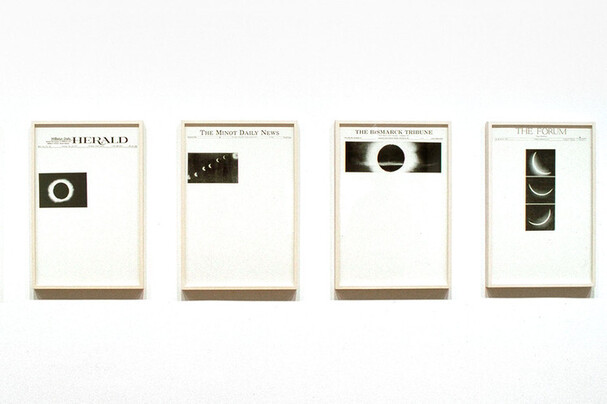
A total solar eclipse occurred in North America on February 26, 1979 in which the central shadow of the moon passed through the American states of Washington, Oregon, Idaho, Montana and through the major Canadian provinces. The eclipse was the talk of the continent and was documented through photography and editorial by local newspapers throughout the states.
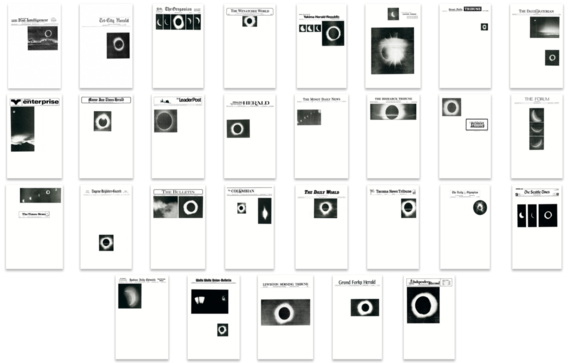
Conceptual artist, Sarah Charlesworth was quick to notice the variations in visual discourse across the front pages of local newspapers and was challenged to produce a new study, The Arc of Total Eclipse. The work examines how photographic images function within editorial practices in newspapers. To produce the work she had to have one fixed variable, common subject matter, in this case this was the total solar eclipse. She then reduced the front pages to their mastheads and front-page photographs. (She called the process of blanking out blocks of text "unwriting.") From this she challenged the viewer to examine the variations that remained such as size of photograph, number of photographs, angle of subject matter and image positioning. All these factors depended on photographers and editors and on the relative importance of the unseen articles sharing the page. The end result is a visual allegory of how varied media perspectives contribute to an understanding of the world. Charlesworth remarked: "The eclipse interested me metaphysically, because there wasn't any single image that was consistent, or even any single point in time represented. Each town along the eclipse path had its own experience of the same event."
Forty years later, in 2020, this is more evident than ever. For the first time in our modern globalised interconnected world the subject matter across all media on all continents and countries is the same. The facts and science of the 2020 pandemic are the same yet perspectives presented to us by media couldn't be any further apart.
As Zimbabwe celebrated 40 years as an independent country during these times I launched an online newspaper The Mutapa Times which essentially aims to address the issue of misinformation in media by taking a page out of Sarah Charlesworth's book. Pun intended. The Mutapa Times is an online newspaper that aggregates Zimbabwean news from foreign press in 3 categories from over 100 different sources to deliver a curated platform for diverse Zimbabwean news. By placing news articles from different sources on one page that have the same subject matter and a focus on one region, Zimbabwe, the reader can easily observe the variations such as title of article and image and how they play a part in communicating the perspective of the media source. In the same way that Sarah placed 29 newspapers from North America with one fixed variable in one gallery room.
The Mutapa Times has a strong emphasis on foreign media to provide an outside-in perspective that is backed by facts and cushioned with compassion.